Korea Life Guide · 한국생활 가이드

[작성자:] 한국 가이드

  • Lost Phone in Korea: How to Locate It, Restore SIM Access, and Get Online

    Lost Phone in Korea: How to Locate It, Restore SIM Access, and Get Online

    If you lose a phone in Korea, start two tasks at the same time: use another device on Wi-Fi to locate and lock the missing phone, and restore essential access on a borrowed or replacement phone. You do not need to wait for the original device to return before accessing maps, email, reservations, and cloud-stored information.

    First, connect to Wi-Fi. Then use Find My for an iPhone or Find Hub for an Android phone to check its location and mark it as lost. Keep device recovery separate from replacing a physical SIM or moving an eSIM, and avoid erasing the phone until you decide that protecting data is more important than continued tracking.

    1. Get online with another device

    A laptop, tablet, borrowed phone, or replacement phone is enough to begin. Wi-Fi lets you sign in to your Apple Account or Google Account, access email, open cloud files, and use device-finding tools.

    Android devices can reconnect to previously saved Wi-Fi networks when Wi-Fi is enabled and the network is nearby. Android also supports Wi-Fi sharing by QR code from another connected Android device. Android Help: Connect to Wi-Fi networks

    • Use Wi-Fi to access maps, email, messaging, and accommodation details.
    • Open cloud storage to confirm which contacts, photos, notes, and documents are already safe.
    • On a borrowed device, use private browsing if available, and sign out when you finish.
    • Do not save passwords on a device that is not yours.

    2. Locate and lock the missing phone

    A phone left in a café, taxi, hotel room, subway station, or shopping bag may be offline or out of battery rather than permanently gone. An unavailable location does not automatically mean recovery is impossible.

    For iPhone

    Sign in to Find Devices through iCloud, or use the Find My app on another Apple device. If Find My was enabled before the phone went missing, you can mark the iPhone as lost and show a contact message on its Lock Screen. Apple Support: Mark a device as lost in Find My

    For Android

    Use Google Find Hub from another Android phone, in guest mode on a friend’s phone, or in a browser. Depending on the device and available connection, it can show a current or last-known location, play a sound, mark the device as lost, or reset it remotely. Android Help: Find, secure, or erase a lost Android device

    Use a minimal recovery message

    Lost phone. Please contact me by email: [your email address]

    Do not put passport details, hotel room information, passwords, or other sensitive information in the message.

    3. Know what needs to be restored

    Losing a handset does not necessarily mean losing your number, cloud data, or accounts. Treat each part separately.

    • The handset: the physical phone, locally stored apps, camera, and settings.
    • A physical SIM: the removable card that provides your mobile number and mobile data.
    • An eSIM: a digital mobile-service profile stored on the phone.
    • Your Apple Account or Google Account: access to synced contacts, email, cloud files, and some backups.
    • Authentication methods: login codes, authenticator apps, backup codes, or recovery email.

    The practical priority is to restore a working internet connection and your main account first. Many cloud-based services can then be restored before the missing phone is recovered.

    4. Set up a replacement phone in the right order

    Do not begin by downloading every app. Restore the accounts and tools that unlock the rest.

    1. Sign in to your Apple Account or Google Account.
    2. Restore access to your primary email account.
    3. Open your password manager, if you use one.
    4. Set up the messaging app used by family, friends, school, or work.
    5. Install maps and translation apps.
    6. Set up your mobile line with a physical SIM or eSIM when available.

    For Android-to-Android setup, Google notes that data connected to the same Google Account in apps such as Calendar, Gmail, and Google Keep can transfer or sync to the new phone. Pixel Phone Help: Transfer data from a previous device

    5. Restore physical SIM or eSIM access

    If the lost phone used a physical SIM

    The original physical SIM remains inside the missing phone unless you recover it. You cannot move that same card to a new device until it is back in your possession.

    Before contacting your mobile provider, have these details ready:

    • Your mobile number
    • The name used for the mobile line
    • Your replacement phone model
    • Whether the replacement phone supports a physical SIM, eSIM, or both
    • Your device IMEI, if requested

    For many Android models, the IMEI may be visible in Find Hub. Android Help: Find, secure, or erase a lost Android device

    If the lost phone used an eSIM

    An eSIM cannot be removed from the lost phone. Transfer or reactivation depends on device compatibility and your mobile provider.

    Some compatible Android phones offer SIM or eSIM transfer during setup or through SIM settings. When an automatic transfer is not available, provider assistance may be needed. Pixel Phone Help: Transfer a SIM to a new phone

    For an eSIM transfer from Android to iPhone, Apple notes that the provider may need to activate the transfer or provide a QR code. After a completed transfer, the SIM on the previous device is deactivated. Apple Support: Transfer your eSIM from Android to iPhone

    Physical SIM and eSIM: what is different?

    • Physical SIM: must be physically recovered to move the original card. A replacement phone may need a replacement SIM from the provider.
    • eSIM: is not removable. Moving service normally requires a compatible transfer flow or provider activation.
    • Both types: require a compatible replacement phone and access to the details associated with the mobile line.

    6. Decide whether to keep tracking or erase the phone

    If recovery still looks realistic, keep the device marked as lost and use Wi-Fi on another device for daily essentials. If the device is clearly unrecoverable, preserve any useful location history and device details before choosing a remote erase.

    Remote erasure is a last resort. It can protect personal data, but it can end continued location access. Google states that an Android device is no longer available in Find Hub after it is factory-reset remotely. Pixel Phone Help: Fix issues with Find Hub Apple also provides a remote erase option through Find Devices. Apple Support: Erase a device in Find Devices

    Common mistakes to avoid

    • Erasing too early: lock and try to locate the phone before using a remote erase.
    • Removing the missing device from your account: do not remove it merely because you have a replacement phone; this can interfere with recovery options.
    • Assuming a blank map is final: the phone may be out of battery, offline, in airplane mode, damaged, or without its SIM.
    • Rebuilding every app at once: start with your main account, email, connectivity, maps, and communication.
    • Relying on one login method: once access is restored, add backup email, alternate verification methods, and stored backup codes where available.

    Frequently asked questions

    Can I find my phone if the SIM has been removed?

    Sometimes. The phone may still be locatable if it connects to Wi-Fi or if compatible offline-location features were enabled beforehand. A removed SIM can also be one reason an Android device location is unavailable. Pixel Phone Help: Fix issues with Find Hub

    Can I use Wi-Fi without a SIM card?

    Yes. A phone can connect to Wi-Fi without an active SIM. You can use a browser, email, maps, and many messaging services after connecting.

    Should I erase my lost phone immediately?

    Usually, no. Try to locate and lock it first. Consider remote erasure only when protecting the data matters more than continued tracking.

    Can I move my eSIM to another phone myself?

    It depends on the phone models and mobile provider. Some compatible devices show an on-screen transfer process, while other transfers need provider activation or a QR code.

    What if login codes are sent to the lost phone?

    Start with services offering another signed-in device, a recovery email, backup codes, or authenticator backup. After regaining access, update your recovery methods before setting up less essential apps.

    Quick checklist

    • Connect another device to Wi-Fi.
    • Locate the missing phone through Find My or Find Hub.
    • Mark it as lost and add a brief contact message.
    • Keep phone recovery separate from SIM or eSIM replacement.
    • Restore your primary Apple Account or Google Account first.
    • Install essential maps, messaging, email, and translation apps.
    • Confirm whether the replacement phone uses a physical SIM, eSIM, or both.
    • Do not erase or remove the lost device until recovery is no longer realistic.

    Information current as of: 2026-09-14

    Sources and references

  • T-money Card Not Working? How to Check Balance and Fix Reader Errors

    T-money Card Not Working? How to Check Balance and Fix Reader Errors

    If your T-money card is rejected at a subway gate or bus reader, stop tapping repeatedly. Check the screen and your remaining balance, then ask station staff to check whether there is an unfinished trip record or a fare adjustment needed.

    For a standard physical T-money card, the quickest fix is often to check or reload the balance at a subway reload machine or a participating convenience store, then tap again with the card removed from your wallet. T-money can be used on public transportation and at affiliated merchants displaying the logo.

    What to do when your T-money card is rejected

    1. Step aside and check the reader screen

    Look for the message, charged amount, and remaining balance on the gate or bus reader. A beep by itself does not always confirm that payment succeeded.

    If a subway gate does not open, do not force it or follow another passenger through it. Move aside and, if possible, note the station, gate, time, bus number, and message displayed. These details help staff investigate the problem.

    2. Check the balance and reload if necessary

    After a successful tap, transport readers normally show the fare and remaining balance. For a clearer check or a rejected card, use a subway reload machine, visit a participating convenience store, or ask station staff.

    Korea Tourism Organization guidance says standard T-money card purchase and charging are generally paid with cash or a Korean-issued credit or debit card. Visitors should keep Korean won available rather than rely on an overseas card for a reload.

    1. Check the card at a subway reload machine.
    2. Reload it if the balance is too low for the next trip.
    3. Try the reader once more with only the T-money card in your hand.
    4. If the card is still rejected, ask station staff before attempting another gate.

    3. Consider whether you missed a tap-out

    For ordinary subway trips, tap when entering and leaving. On buses, tap when boarding and again when getting off. Korea Tourism Organization guidance notes that failing to tap out of a bus prevents the normal transfer discount.

    If you may have missed a bus or subway exit tap, do not try to correct the record by tapping at multiple gates. Go to the station office and explain where and when you last used the card.

    4. Remove the card from your wallet or phone case

    Other contactless cards or devices can make a clean tap difficult. Remove the T-money card from your wallet, card holder, or phone case. Hold only that card still against the reader until the display changes.

    Do not tap again unless the first attempt clearly failed. Repeated taps can make it harder to understand whether a fare was charged.

    5. Try another reader once, then seek help

    A single reader may have a problem. At a subway station, try one nearby gate once; on a bus, tell the driver immediately if the front reader does not accept the card. If the issue continues, use the station office instead of testing many readers.

    What to ask station staff

    Look for a station office, Customer Safety Office, or information desk near the ticket gates. Exact locations vary by station. Show your card and use short, specific questions.

    • “My T-money card was rejected at the gate. Can you check the reason?”
    • “Could you check whether I have an unfinished trip?”
    • “I may have forgotten to tap out of the bus or subway.”
    • “Can you check my remaining balance?”
    • “Did this card charge me just now?”
    • “Can you help me adjust the fare so I can exit?”

    Useful Korean phrases:

    • 티머니 카드가 안 돼요. “My T-money card is not working.”
    • 잔액이 부족한가요? “Is the balance insufficient?”
    • 하차 태그를 못 했어요. “I could not tap out.”
    • 정산 부탁드려요. “Please help me adjust the fare.”

    Costs, locations, and choosing the right solution

    When reloading is the right choice

    Reload first when the issue is clearly insufficient balance, the card works after being removed from your wallet, or staff confirm that the travel record can be adjusted. A subway reload machine is usually the best option for a transport problem because station staff are nearby if the card remains rejected.

    Participating convenience stores that display the T-money logo can also be useful for ordinary purchase, balance checks, or reloads. Available services can vary by store.

    When to consider a replacement card

    Consider a replacement only if the card fails consistently at different readers after a balance check, or if station staff or T-money advises that the card may be defective. Keep the old card until you have checked its remaining balance and the applicable refund or transfer options.

    Published tourism guidance has listed regular physical T-money cards at approximately ₩3,000 to ₩5,000 for the card itself, separate from loaded value. Confirm the current selling price and reload limits at the point of purchase, as they may change.

    Where to get help

    • Subway station office: Best for an entry, exit, gate, or unfinished-trip issue.
    • Convenience store with a T-money logo: Useful for routine balance checks and reloads where offered.
    • T-money customer support: Best for a continuing card issue, possible physical-card fault, or balance and refund questions. T-money lists +82-1644-0088 on its English contact page; confirm current availability and language support directly.
    • 1330 Korea Travel Helpline: Useful for general travel information or communication help, but not a substitute for station staff or T-money support for a card record problem.

    Important cautions

    • Use a separate transport card for each traveler unless a transport operator specifically permits another arrangement.
    • Do not climb over a gate or use an emergency exit unless staff direct you to do so.
    • Do not assume a T-money card works for every rail service. Reserved and long-distance services may require a separate ticket.
    • Do not confuse T-money with the Climate Card; their coverage, charging, and refund rules differ.
    • Keep the card and any reload receipt until the issue is resolved, especially if you think a reader charged you without opening a gate.
    • An anonymous physical card can be difficult to recover if lost. Keep it separate from essential documents and bank cards.

    FAQ

    Can I check my T-money balance at a subway gate?

    After a successful tap, the reader normally displays the fare and remaining balance. If the card is rejected, use a reload machine, a participating convenience store, or ask station staff for a balance check.

    Why did my T-money card stop working after I got off a bus?

    You may have missed the exit tap. This can affect transfer treatment. Tell staff where you boarded, which bus you used if known, and when you got off.

    Can I reload T-money with a foreign credit card?

    Do not rely on it. Korea Tourism Organization guidance says standard T-money purchase and charging are generally handled with cash or a Korean-issued credit or debit card. Carry Korean won as a dependable backup.

    My card works in a convenience store but not at the subway gate. What should I do?

    Go to station staff with the card. The issue may involve a previous transport record or a station-side fare adjustment rather than the stored balance.

    Can station staff refund my remaining balance?

    Do not assume every station can handle every refund or damaged-card case. The available process can depend on the card type, balance amount, and current T-money policy. Ask staff where your case should be handled before discarding the card.

    Is 1330 the right number for a T-money card problem?

    1330 is a travel-information helpline. For a gate problem, ask station staff first. For an issue that continues across multiple readers, use T-money customer support.

    Transport-card services, payment methods, prices, and refund procedures can change. Check the current information displayed at the reload machine or station and confirm ongoing card issues with T-money customer support. General card-use and reload guidance is available from Korea Tourism Organization.

    Related articles

    Information current as of: 2026-09-13

    Sources and references

  • How to Take a Seoul Taxi Without a Korean Phone Number

    How to Take a Seoul Taxi Without a Korean Phone Number

    You do not need a Korean phone number to take a regular licensed taxi in Seoul. The most dependable choices are using a marked taxi rank, hailing an available taxi from the street, or asking a hotel or other staffed venue to call one.

    Prepare your destination’s Korean road address before you leave. A Korean number mainly matters when creating or verifying an account in a taxi-hailing app, not when taking a taxi that is already waiting or stopping for you.

    Use a taxi rank or hail an available taxi

    For visitors using a foreign SIM or a data-only eSIM, a taxi rank is often easier than trying to register for an app. Taxi stands are common near major subway stations, hotels, department stores, hospitals, and transport hubs. Seoul’s guidance notes that they are often near bus stops.

    1. At a taxi rank, join the line and take the next available taxi.
    2. To hail a taxi, stand where the driver can pull over safely. Do not stand in a traffic lane, bus-only area, or busy intersection.
    3. Check the windshield status sign rather than relying on the taxi’s color.
    4. Wave for 빈차 (bincha, vacant or available), generally shown in red.
    5. Do not wave for 예약 (yeyak, reserved), generally shown in green.

    Seoul advises passengers to wait at a taxi stand or hail safely from the edge of the sidewalk when no taxi is waiting there. See Seoul’s official taxi guidance.

    Show your destination in Korean

    A clear Korean address is usually more useful than a Korean phone number. Drivers may not be able to identify an English hotel name or spoken English address. Save screenshots of the following before you look for a taxi:

    • Your accommodation’s Korean road address
    • The Korean name of the hotel or building, if available
    • A map pin
    • The nearest subway station or well-known landmark
    • Your hotel’s front-desk phone number

    여기로 가 주세요. — “Please take me here.”

    You can simply show this phrase together with the Korean address and map. For a large mall, hospital, university, or apartment complex, add the specific building or entrance when possible.

    Ask a hotel or staffed venue to call a taxi

    Ask a hotel, hostel, restaurant, attraction desk, or serviced residence to call a taxi if it is raining, you have heavy luggage, your pickup point is difficult to find, or you are travelling very early or late.

    Confirm whether the vehicle is an ordinary metered taxi, an app-dispatched taxi, or a separate transfer service. Do not assume that every arranged ride uses the same fare method.

    Can taxi apps work without a Korean number?

    Data-only eSIM users

    A data-only travel eSIM provides internet access, but normally does not receive ordinary SMS messages on its own. If an app asks for a verification code, you need a separate number that can receive it. Keep your home SIM available if your mobile plan permits this, and check roaming charges with your carrier. An already verified account may still work over the eSIM’s data connection.

    Uber’s account guidance also requires a valid phone number verified by SMS. A foreign number may work if it can receive verification messages and is accepted by the service, but verify your account before you need an urgent ride.

    k.ride and Kakao T

    k.ride is Kakao Mobility’s app for international travelers. VISITKOREA says it does not require a KakaoTalk account and supports registering an overseas credit card. Its official site lists English menus, translated driver chat, fare estimates, and automatic card or mobile payments.

    1. Open k.ride and complete the sign-in steps shown for your account. Check any verification and payment requirements before relying on it.
    2. Set your pickup pin at a legal stopping point and enter your destination. Check the building and entrance on the map.
    3. Choose a vehicle and review the estimate, payment method, and any service or cancellation fee before confirming.
    4. After dispatch, match the license plate and use in-app chat if the driver cannot find you.

    For Kakao T, VISITKOREA describes signing up through a Kakao account with your home-country mobile number. A foreign number and having no usable number at all are different situations. Test registration in advance; if it fails, use a taxi rank or ask your hotel to call. Official guide to Kakao T and k.ride.

    Practical app rule

    • No Korean number and no SMS-capable foreign number: use a taxi rank, street hail, or hotel call.
    • Foreign SIM that receives SMS: set up and test your preferred app before your trip or before you need it.
    • Existing verified Uber account: check live availability, pickup details, displayed fare information, and payment choices before requesting.

    Uber’s official Seoul page lists local licensed taxi options and says riders can select in-person cash or card payment at the end of a trip. Availability and payment choices can change, so check the app before booking. Uber account verification help · Uber Seoul taxi information

    Choose, pay, and keep a receipt

    For most short and medium journeys within Seoul, a regular sedan taxi is the straightforward option. Seoul states that licensed taxis use a meter unless a separately approved fare plan applies. Larger vans, deluxe taxis, and app products can use different fare structures, so check the fare type before accepting the ride.

    Seoul’s official guidance lists cash, credit cards, and public transportation cards as taxi payment methods. However, acceptance of a particular foreign-issued card can vary by card, network, terminal, and merchant setup. Carry a backup payment method, such as another card, Korean won, or a loaded transportation card where practical.

    1. Check the meter or payment screen before paying.
    2. For an app ride, confirm whether payment is in the app or paid to the driver.
    3. Ask for a receipt: 영수증 주세요 (yeongsujeung juseyo, “Receipt, please.”).
    4. Keep the receipt after you leave the taxi, until you have checked all your belongings and the payment.

    A receipt can help if you leave belongings behind. If it is safe to do so, also note the taxi’s license plate, pickup time, and drop-off location. For a recovery checklist, see Lost Something in Korea? Subway, Taxi, Airport and LOST112 Steps.

    Fares, airport trips, and choosing the right ride

    Seoul’s published taxi guide lists a regular sedan daytime base fare of ₩4,800 for the first 1.6 km, followed by distance and time charges. Its regular sedan late-night surcharge is 20% from 10–11 PM, 40% from 11 PM–2 AM, and 20% from 2–4 AM. A 20% surcharge can apply outside the service area; joint service areas and airport routes have specific rules. Check the fare type and meter, especially on a trip outside Seoul.

    A normal street-hailed ride is not a fixed-price service. The final amount depends on distance, traffic, waiting time, applicable surcharges, and tolls. Seoul states that tolls are collected at the actual amount when a passenger requests a toll route. Check Seoul’s official taxi fare information.

    At an airport, use the official taxi stands rather than accepting unsolicited ride offers inside the terminal. For transport choices from Incheon Airport, including when a taxi makes sense compared with AREX or buses, read Incheon Airport to Seoul: AREX, Bus or Taxi?. For late arrivals, see Incheon Airport to Seoul After Midnight: Night Bus, Taxi & Late-Night Options.

    Safety and common mistakes

    • Use official taxi ranks at airports and major transport locations. Do not follow unsolicited ride offers.
    • For a street-hailed regular taxi, check that the meter is running after departure.
    • For an app ride, avoid paying twice if the trip was already paid in advance.
    • Keep the receipt, license plate, route details, and any app trip screenshot for fare questions or lost-property reports.

    For a Seoul taxi service complaint, the city advises recording the full license plate number and contacting the 120 Dasan Call Center. For English assistance, its guide lists 02-120, then 9, then 1, during 9 AM–6 PM KST. If your data-only eSIM cannot make a voice call, ask your hotel for help or use the city’s taxi complaint QR guidance. In an immediate emergency, call 112 for police or 119 for fire, ambulance, or serious medical assistance.

    If you are still planning connectivity and payment backups, see Korea SIM vs eSIM vs Pocket Wi-Fi: Which Should You Choose? and How to Pay in Korea: Foreign Cards, Cash and Mobile Payments.

    Frequently asked questions

    Do I need a Korean phone number to hail a Seoul taxi?

    No. You can use a taxi rank, hail an available taxi, or ask a staffed venue to call one. Phone-number requirements are mainly relevant to app account registration and verification.

    Can I use Kakao T with a data-only eSIM?

    Internet access alone does not guarantee that you can register. If Kakao T asks for SMS verification, use a separate SMS-capable number. Set up and test the account before your trip; otherwise use a taxi rank, street hail, or hotel call.

    Can I use Uber in Seoul without a Korean number?

    Uber requires a valid phone number verified by SMS, but its cited account guidance does not state that the number must be Korean. If your existing account or foreign SIM can complete verification, check the live app before relying on it.

    Can I pay with a foreign credit card?

    Seoul lists credit cards as a taxi payment method, but a particular foreign card may not work at every terminal. Bring a backup payment method.

    Should I tip a taxi driver?

    For a standard taxi ride, pay the metered fare or the app fare shown. Do not assume that an additional tip is required.

    Information current as of: 2026-09-12

    Sources and references

    Related articles

  • Korea D-10-1 Job Seeker Visa: Eligibility, Documents, and Rules While Looking for Work

    Korea D-10-1 Job Seeker Visa: Eligibility, Documents, and Rules While Looking for Work

    If you need to remain in Korea while seeking a professional job, the relevant status is generally D-10-1 (Job Seeker). It is intended for job seeking in fields that may lead to an E-1 through E-7 work status, not for unrestricted employment or for finding any type of part-time job.

    A practical path is to confirm that your target role fits the professional pathway, prepare a documented job-search plan, apply for a change or extension before your current stay expires, and change to the appropriate work status once hired. A job offer alone does not authorize you to begin work under D-10-1.

    Requirements can differ by prior status, education, career history, nationality, filing location, and the reviewing office. Confirm your exact document list, fee, and permitted stay period through the official channel immediately before filing.

    Who may qualify for D-10-1?

    D-10-1 is most relevant to international graduates and foreign professionals already in Korea who are preparing for employment in an eligible professional field. Typical situations include moving from D-2 after graduation, seeking a new qualifying employer after professional employment, or preparing for permitted professional-field internship activity.

    The intended role must be connected to a professional employment pathway, generally E-1 through E-7. It is not designed as a bridge to E-8, E-9, or other non-professional employment routes. The Ministry of Justice’s foreign-resident guide describes D-10 as covering job seeking, start-up preparation, and specified high-tech internship activities; D-10-1 is the job-seeking route.

    Points route and possible exemptions

    An official consular D-10-1 checklist states that the standard points route generally requires a bachelor’s degree or higher, with a Korean associate degree included in the stated route, at least 20 points in the basic category, and at least 60 points out of 190 overall.

    Some applicants may be exempt from the usual points review. For example, the checklist describes a route for people who obtained a Korean associate degree or higher within the preceding three years and meet the listed Korean-language or KIIP requirement. Do not assume an exemption applies based only on a degree, university ranking, or language score: check the current criteria and evidence requirements.

    Application conditions and documents

    The exact checklist differs for an overseas visa application, a change of status in Korea, and an extension of D-10-1. The following documents are commonly central to an application:

    • Application form, passport, and a passport photograph if required
    • Alien Registration Card for an in-country application
    • Degree certificate and, where relevant, academic records
    • Career or employment certificates supporting claimed experience or points
    • TOPIK or KIIP evidence when relevant
    • Proof of Korean address and financial ability, where required
    • A detailed job-seeking plan

    For applications submitted abroad, a Korean embassy or consulate may require apostille or legalization for education and career documents. The Korea Visa Portal notes that a diplomatic mission’s local instructions may take priority over the general Visa Navigator list.

    Write a credible job-seeking plan

    Your plan should connect your background to a realistic target occupation. Include the roles and industries you are targeting, the employers or employer types you will approach, planned application and interview activity, and skills or portfolio work you will complete. When extending D-10-1, also document the job-search activity completed during the previous period.

    A plan saying only “I want to find a job in Korea” is weak. A stronger plan identifies, for example, data analyst or software developer roles, relevant employers, portfolio improvements, and how a data-science degree and prior experience support those targets.

    Application procedure

    1. Choose the correct route. Applicants outside Korea generally apply through the Korean embassy or consulate with jurisdiction over their residence. People in Korea generally apply for a change of status or an extension, depending on their current status.
    2. Check the current filing instructions. Use the applicable official immigration channel and the competent office’s instructions. File before your authorized stay expires.
    3. Prepare consistent evidence. Names, dates, academic history, work history, points claims, address documents, and your job plan should not conflict with one another.
    4. Submit and provide originals if requested. Reviewing authorities may request supplementary documents. Keep originals available even when a filing process accepts uploaded scans.
    5. Change status before beginning qualifying employment. Once hired, obtain the status or permission matching the actual role, often an E-series professional status, before starting work.

    Fees and processing time

    There is no single reliable D-10-1 fee or processing-time figure for every case. Charges may differ depending on whether you apply overseas, change status in Korea, extend stay, or use an online service. Processing also varies with document verification, translations or apostilles, points assessment, and requests for additional evidence.

    Confirm the current fee and expected processing guidance with the official filing channel immediately before applying. Do not rely on an older fee table, social-media post, or another applicant’s timeline.

    Stay period and internships: important cautions

    A Ministry of Justice announcement describes a reform effective October 29, 2025 that increased the D-10 job-search period from six-month extensions with a two-year total to grants of up to one year and a maximum total of three years. The same announcement describes revised internship rules, including a maximum of one year at one company.

    However, older government-facing information still shows the previous six-month and two-year framework. Do not assume that every D-10-1 holder will receive a one-year grant or the full three-year total. Confirm the period available in your individual case with the competent immigration office.

    D-10-1 is not an open work permit

    Do not begin paid work simply because you hold D-10-1. Korean immigration law limits employment activities to those allowed under the person’s status of stay. An internship may also require confirmation that the position, employer, professional field, duration, and any permission or reporting requirements fit your case.

    • Do not start work before the required status change or permission is approved.
    • Do not treat every position labeled “internship” as automatically permitted.
    • Do not claim points without the required documentary proof.
    • Do not reuse an old plan without showing recent job-search activity.
    • Do not wait until the final days of stay to resolve missing transcripts, apostilles, or address documents.

    D-10-1 compared with other statuses

    D-2 student

    D-2 is for full-time study at an eligible Korean institution. Study remains the main purpose, and employment is not automatically unrestricted.

    D-10-1 job seeker

    D-10-1 is for seeking a professional role that may lead to E-1 through E-7. It is not a general work visa.

    E-1 through E-7 work statuses

    These statuses are for approved employment in a qualifying role. The role and employer must meet the requirements of the relevant category.

    D-8 and F-series statuses

    D-8 is for qualifying investment or business activity rather than ordinary job seeking. F-series residence statuses have different eligibility bases, and work rights depend on the specific F category.

    Frequently asked questions

    Can I change from D-2 to D-10-1 after graduation?

    Often, this is a common route for international graduates seeking professional employment in Korea. You must still meet the applicable requirements and provide a job-seeking plan and supporting documents.

    Can I work full time on D-10-1?

    No. D-10-1 is for job seeking, not unrestricted employment. Change to the appropriate work status before beginning the qualifying job.

    Do I need TOPIK?

    Not every applicant follows the same route, but Korean-language evidence can support a points claim and may be required for certain exemptions. Official D-10-1 guidance specifically recognizes TOPIK and KIIP in relevant circumstances.

    Can I extend D-10-1 if I have not found a job?

    An extension may be possible if you remain eligible and show a genuine, continuing job search. The available period and total stay must be confirmed for your individual route because public guidance has not always displayed the same duration framework.

    What should I check before filing?

    • Confirm that your target job fits the E-1 through E-7 professional pathway.
    • Check whether you meet the points route or a documented exemption.
    • Prepare education, career, language, address, and financial documents in the required format.
    • Link your job-seeking plan to realistic roles and employers.
    • Recheck the current documents, fees, and stay period before filing.

    Official sources

    Related Korea visa guides

    Professional immigration help

    If you need help checking your Korean visa eligibility or preparing an immigration application, Darum Administrative Office is a Ministry of Justice-registered immigration application agency.

    Immigration & Visa Consultation →

    Information checked September 27, 2026. Requirements vary by application route and individual circumstances; verify the current checklist with the responsible immigration office before filing.

  • D-8-1 Korea Investor Visa: How Foreign Founders Can Start a Business in Korea

    D-8-1 Korea Investor Visa: How Foreign Founders Can Start a Business in Korea

    For a foreign founder who will invest in and personally operate a Korean corporation, the usual route is the D-8-1 Corporate Investment visa. Under the standard foreign direct investment structure, an investor generally invests at least KRW 100 million in a Korean corporation and acquires at least 10% of its voting shares.

    Those figures do not guarantee a D-8-1 visa. You must also show a properly documented investment route, a genuine operating business in Korea, and your own active role in management, administration, production, or technology. Passive share ownership or a company that exists only on paper is not the purpose of this status.

    Who is eligible for D-8-1?

    D-8 is an investor-related stay category for essential foreign professionals at foreign-invested companies. The legal framework describes relevant work as management, administration, production, or technical activity, and excludes work that can ordinarily be filled by locally hired personnel. See the Immigration Control Act stay-status schedule.

    For a typical D-8-1 founder case, you should be able to demonstrate all of the following:

    • You establish a Korean corporation or invest in an existing Korean corporation.
    • Your investment meets the applicable foreign direct investment framework, commonly KRW 100 million or more per foreign investor and 10% or more of voting shares.
    • You will serve as an investor, executive, manager, or essential specialist rather than a passive shareholder.
    • The company has a credible business site, business purpose, funding trail, and operational evidence.

    InvestKOREA explains the D-8 corporate-investment route and the role of an essential professional in its visa application guidance.

    Show why the business needs your role

    A concise but specific business plan is more useful than a broad statement that you intend to open an online business. Explain what you sell, who your customers are, how revenue will be earned, where operations will occur, how capital will be used, and what you will personally manage or perform.

    Application conditions and documents

    Use the correct corporate and investment structure

    D-8-1 normally concerns a Korean corporation recognized as a foreign-invested company. InvestKOREA states that foreign direct investment recognition generally involves an investment of at least KRW 100 million for management participation and acquisition of at least 10% of newly issued or existing voting shares.

    A foreign-invested company is a Korean domestic corporation. It is different from a branch of an overseas company and from a liaison office. A liaison office cannot conduct profit-making activities. For an overview of these structures, consult InvestKOREA’s guide to starting a business in Korea.

    Check the industry before committing funds

    Foreign investment is broadly permitted, but some activities are restricted, prohibited, or subject to separate conditions. Check the current rules for the precise activity you will conduct, especially in regulated sectors or where separate licences may be required. The relevant legal information is available through the National Law Information Center.

    Documents commonly requested

    The exact checklist differs by application channel, nationality, business model, and whether you apply abroad or seek a change of status in Korea. The reviewing authority may request additional evidence. Common supporting documents include:

    • Visa or stay-status application form, passport copy, and photograph
    • Foreign-invested company registration certificate
    • Business registration certificate and corporate registration certificate
    • Share subscription, share purchase, or shareholder-change documents where applicable
    • Foreign investment notification and proof that investment funds entered Korea
    • Bank remittance, foreign-exchange, and corporate bank-account records
    • Evidence of how invested capital was used, such as invoices and receipts
    • Office lease or other proof of a genuine business site
    • Business plan, contracts, sales records, and other operational evidence where available
    • Industry experience, tax, employment, or dispatch documents if requested for the specific case

    Keep names, investment amounts, ownership percentages, bank records, corporate filings, lease documents, and business-plan details consistent with one another.

    How to start the business and apply for D-8-1

    1. Choose the right structure. Confirm whether a Korean corporation is appropriate. A foreign-company branch, liaison office, individual business, or technology start-up may lead to a different immigration route.
    2. Confirm that your activity is permitted. Review foreign-investment restrictions and any sector-specific licence requirements before signing commitments or transferring funds.
    3. File the foreign investment notification. For a new-share investment, this is generally completed before capital is remitted. InvestKOREA notes that notification may be made through delegated institutions such as KOTRA or eligible foreign-exchange banks.
    4. Remit capital through a traceable route. Retain source-of-funds evidence, remittance confirmations, foreign-exchange records, and corporate bank records. Do not assume an informal transfer, cash payment, or transfer through a personal Korean account will establish qualifying investment.
    5. Incorporate and register the company. Complete corporate registration, business registration, and foreign-invested company registration as applicable.
    6. Prepare evidence of real operations. Obtain an appropriate business location and preserve records showing capital expenditure, contracts, suppliers, customers, or other activity that fits your business model.
    7. Apply through the correct visa channel. Applicants outside Korea normally apply through the relevant Korean diplomatic mission or visa-issuance procedure. A person already in Korea may be able to apply for a change of status only where permitted.
    8. Complete resident-registration obligations after approval. If foreigner registration applies to your authorized stay, follow the current deadline and procedure confirmed by the competent immigration office.

    Costs and processing time

    There is no single all-inclusive D-8-1 cost or universal processing-time promise. Your budget may include company incorporation and registration expenses, office deposit and rent, operating costs, document translation or legalization, banking charges, and visa or immigration application fees.

    Fees can differ by embassy, nationality, reciprocity arrangements, filing method, and application type. Processing time can depend on document completeness, requests for additional evidence, the application channel, and the complexity of the business. Confirm current fees, forms, and timing with the embassy or immigration office that will process your case immediately before filing.

    Important cautions

    Do not treat KRW 100 million as a visa guarantee

    The investment amount and shareholding threshold are central to the standard investment structure, but immigration can still assess the source and route of funds, the company’s actual activity, and your qualifying role. A balance temporarily placed in an account is not the same as a well-documented investment supporting a real business.

    Maintain a complete money trail

    Keep personal source-of-funds records, investment notification documents, remittance and exchange records, corporate bank statements, share documents, invoices, and receipts. Funds that cannot be traced to the applicant or that are withdrawn without a documented business purpose can weaken the file.

    Make sure the site fits the business

    An office lease or equivalent proof of a business site is commonly requested. The location should credibly support the activity claimed. A virtual-office arrangement is not automatically addressed as acceptable or unacceptable in the official materials cited here; its suitability can depend on the business type and the overall evidence of actual operations.

    Check whether you can change status in Korea

    Do not assume every visitor can change to D-8 from inside Korea. InvestKOREA states that certain tourist and other statuses, including specified C-3 statuses and D-3, E-9, E-10, H-2, G-1, and H-1, are not permitted to change to D-8 while in Korea. Your present status and immigration history matter, so verify the current rule for your situation before relying on an in-country application.

    Keep records for an extension

    Extensions may require more than the original investment certificate. Maintain corporate and tax records, bank statements, lease renewals, contracts, invoices, staffing records where applicable, and evidence of your continuing management or specialist role. Material changes, such as a share transfer, closure, representative-director change, or major business change, may affect your stay status and may trigger reporting or permission requirements.

    D-8-1 compared with other business-related statuses

    D-8-1: corporate investment

    This is generally the standard route when you invest in and personally operate a Korean corporation under the qualifying foreign direct investment structure.

    D-8-2: venture business

    This is a separate venture-focused category and may involve qualifications beyond ordinary corporate investment.

    D-8-3: individual business investment

    This is distinct from D-8-1. Do not assume that opening a sole proprietorship independently will qualify for D-8-1; examine the structure and current requirements carefully.

    D-8-4: technology start-up

    This is a separate pathway for qualifying technology-based start-ups rather than the ordinary capital-investment route.

    D-9: trade or business management

    D-9 may be more relevant to certain trade or profit-making individual-business activities. It should be considered when your project does not fit the foreign-invested Korean corporation model.

    D-7: intra-company transferee

    D-7 generally concerns a qualifying transfer from an overseas company to a related Korean entity. It is based on the employment and transfer relationship, not simply on personal investment.

    The Korea Visa Portal lists D-8 subcategories separately, including D-8-1, D-8-2, D-8-3, and D-8-4. Select the status based on the actual corporate structure and activity, not the label that appears easiest to obtain.

    Frequently asked questions

    Is KRW 100 million enough to guarantee D-8-1 approval?

    No. It is a core element of the standard foreign direct investment framework, but it does not by itself prove eligibility. You must show a qualifying investment structure, traceable capital, a genuine business, and a credible investor or essential-professional role.

    Can I get D-8-1 by opening a sole proprietorship?

    Do not assume so. D-8-1 ordinarily concerns investment in a Korean corporation. Depending on the facts, D-8-3 or D-9 may be more relevant. Confirm the current classification before establishing the business.

    Can I own less than 10% if I invest KRW 100 million or more?

    Foreign-investment rules include limited structures involving an investment of at least KRW 100 million and the appointment or dispatch of an executive even where ownership is below 10%. That foreign-investment treatment should not be treated as automatic D-8 visa eligibility. Confirm how immigration will assess your exact ownership and management arrangement.

    Can I apply as a tourist after incorporating a company?

    Not always. Some tourist and other stay statuses cannot be changed to D-8 from within Korea. Check the current status-change rule before you incorporate or make a launch schedule that depends on applying in Korea.

    Can I work for another Korean company while holding D-8?

    Do not assume that outside work is permitted. D-8 is linked to the approved investor or essential-professional activity at the foreign-invested business. Separate work may require immigration review or authorization.

    Final pre-application checklist

    • Confirm that the industry and planned activity are open to foreign investment.
    • Choose the correct business structure and stay status before sending capital.
    • File the foreign investment notification before remittance where required.
    • Preserve a complete source-of-funds, remittance, and corporate banking trail.
    • Make sure the investment amount, voting-share ratio, corporate documents, and business plan match.
    • Prepare credible evidence of the business location and actual operations.
    • Check whether your current status permits an in-country change to D-8.
    • Verify the current document list, fees, forms, and filing channel with the competent embassy or immigration office before submission.

    Related Korea visa guides

    Professional immigration help

    If you need help checking your Korean visa eligibility or preparing an immigration application, Darum Administrative Office is a Ministry of Justice-registered immigration application agency.

    Immigration & Visa Consultation →

    Information current as of: 2026-09-10

    Sources and references

  • Namdaemun vs Dongdaemun vs Dongmyo: Which Seoul Market Should You Visit?

    Namdaemun vs Dongdaemun vs Dongmyo: Which Seoul Market Should You Visit?

    Short answer: Choose Namdaemun for the broadest mix of practical Korean goods, gifts, food, and traditional-market atmosphere. Choose Dongdaemun for fashion, fabric, accessories, and creative supplies. Choose Dongmyo for second-hand clothing, retro objects, and an unplanned vintage treasure hunt.

    For most first-time visitors, Namdaemun is the easiest all-round choice. Dongdaemun is the better match when fashion or making something is your priority, while Dongmyo is most rewarding for patient browsers who enjoy discovering one-of-a-kind used items.

    Choose a market in 30 seconds

    • Go to Namdaemun if you want gifts, kitchenware, accessories, clothes, snacks, or everyday items in one market area.
    • Go to Dongdaemun if you want finished fashion, fabrics, ribbons, buttons, hanbok materials, or DIY supplies.
    • Go to Dongmyo if you want used clothes, vinyl, old books, retro objects, and the fun of browsing without a fixed list.

    If you only have time for one market and have no specific shopping mission, pick Namdaemun. If your interest is already clear, choose the market that matches it instead of trying to see all three.

    Namdaemun: best for variety and a classic market experience

    Namdaemun Market is described by VISITKOREA as Korea’s largest traditional market. Its strength is range: clothing, accessories, kitchenware, toys, stationery, mountain gear, flowers, food, imported products, and many other categories are concentrated in a dense market district.

    This is not one indoor building. It is a network of lanes, stalls, storefronts, and specialist sections near Namdaemun Gate. You can arrive looking for a souvenir and easily find useful household goods, a snack, or an unexpectedly specific item along the way.

    Namdaemun is a good fit for

    • First-time visitors looking for one traditional Seoul market
    • Travelers shopping for practical gifts rather than only decorative souvenirs
    • People who enjoy comparing many product categories
    • Visitors exploring central Seoul, including the areas around Myeong-dong or Seoul Station

    How to shop at Namdaemun

    1. Start with one category, such as accessories, kitchen items, stationery, or gifts.
    2. Walk through more than one lane before choosing between similar products.
    3. Check the material, finishing, size, and whether an item is intended for regular use.
    4. Leave time for browsing: variety is the main reason to visit.

    When Namdaemun may not be your best choice

    Namdaemun can feel overwhelming if you want one specific fashion style or a carefully curated vintage selection. It is strongest for breadth and practical discovery, not for a single fashion mood.

    Dongdaemun: best for fashion, fabric, and creative shopping

    Dongdaemun is best understood as a shopping district, rather than a single market. It includes fashion-focused buildings, apparel shopping, wholesale-oriented spaces, the Dongdaemun Shopping Complex, and design landmarks. The Official Travel Guide to Seoul highlights the district’s role as a major shopping area.

    Compared with Namdaemun, Dongdaemun is more focused on fashion and the materials behind fashion. The Dongdaemun Shopping Complex is associated with textiles and hanbok shops, while VISITKOREA also introduces the area as a place to find materials such as fabrics, buttons, ribbons, and accessories for custom projects.

    Choose Dongdaemun if you want to

    • Browse clothing and fashion accessories
    • Buy fabric, trims, buttons, ribbons, or other sewing supplies
    • Look for hanbok fabrics and related materials
    • Make, alter, decorate, or customize clothing and accessories
    • Pair shopping with a design- and architecture-focused walk

    Pick the right version of Dongdaemun before you go

    1. Finished fashion: focus on apparel-oriented malls and fashion buildings.
    2. Fabric and notions: look for the Dongdaemun Shopping Complex and materials sellers.
    3. Traditional clothing materials: search for hanbok fabrics and accessories.
    4. DIY supplies: seek out buttons, ribbons, charms, and craft components.
    5. Design-focused sightseeing: combine your shopping time with the surrounding design district.

    This step matters because a common mistake is expecting boutique-style ready-to-wear clothing, then entering a supply-focused building—or expecting fabric and finding fashion retail instead.

    When Dongdaemun may not be your best choice

    Dongdaemun is less suited to a relaxed antique hunt or a classic, lane-by-lane traditional market stroll. If you do not care about fashion, textiles, or making things, Namdaemun will often feel more immediately rewarding.

    Dongmyo: best for vintage finds and slow browsing

    Dongmyo is the most unpredictable option, which is exactly its appeal. Around Dongmyo Shrine, flea-market stalls and nearby shops offer a changing mix of second-hand clothing, books, posters, watches, tableware, toys, vinyl, household goods, and retro objects. The Official Travel Guide to Seoul describes both the flea-market atmosphere and the curated vintage shops in the area.

    Go to Dongmyo for the hunt, not for a guarantee. It is not the right place to expect a particular item in a particular size or condition. It is a place to inspect, browse, and occasionally find something memorable.

    Dongmyo is a good fit for

    • Vintage and second-hand clothing fans
    • People interested in old books, records, posters, cameras, or retro objects
    • Visitors who like styling outfits from unexpected pieces
    • Photographers drawn to dense, character-filled market scenes
    • Browsers who are happy to leave without buying anything

    Flea stalls or curated vintage shops?

    Flea-market stalls are for true treasure hunting. Stock can be mixed, irregular, and loosely organized, so inspect every item carefully.

    Nearby curated vintage shops are a better choice if you like the Dongmyo look but prefer selected items in a more organized setting. Trying both gives you the fullest picture of the neighborhood.

    When Dongmyo may not be your best choice

    Dongmyo is not ideal when you need reliable sizing, pristine condition, easy product comparison, or a specific branded item. Treat it as a browsing destination first and a shopping destination second.

    The real differences at a glance

    • Namdaemun: practical browsing across many categories.
    • Dongdaemun: fashion, textiles, materials, and creative shopping.
    • Dongmyo: second-hand finds and unplanned treasure hunting.
    • Namdaemun mindset: “I need useful gifts or everyday goods.”
    • Dongdaemun mindset: “I want fashion, or supplies to make something.”
    • Dongmyo mindset: “I want to see what I can discover.”

    Smart shopping tips for all three markets

    Know what kind of shopping you are doing

    Namdaemun combines everyday retail and wholesale-oriented activity. Dongdaemun includes consumer shopping as well as supply-focused buildings. Dongmyo centers on used and irregular stock. Ask whether an item is sold individually, whether you can inspect it before purchase, and whether the displayed item is the exact item you will receive.

    Inspect items before paying

    • Check zippers, buttons, seams, and fabric wear.
    • For second-hand clothing, look for stains, odors, or damage.
    • For electronics or mechanical items, check visible condition closely.
    • Use measurements as well as label sizes.
    • Confirm whether accessories are sold as a set or individually.

    Confirm payment and total at the shop

    Payment methods can differ by individual shop or stall. Ask the seller how they prefer to be paid before committing to an item, and confirm the total before it is packed. Prices and payment options vary by seller, so check on site.

    Take photos thoughtfully

    A photo can help you compare products or remember where you saw an item, but ask before photographing merchandise displays or vendors. A quick polite question is especially useful in compact, busy market lanes.

    Do not depend on one exact shop recommendation

    Stock and tenants can change. Search for the district, a broad product category, or the Korean name of a building instead of relying entirely on a single social-media post. The best visits leave room for detours.

    If you have time for only one market

    Choose Namdaemun for the most balanced traditional-market experience.

    Choose Dongdaemun when fashion, fabric, accessories, DIY materials, or design are central to your day.

    Choose Dongmyo when a strange, personal, used, or vintage find sounds more appealing than a standard souvenir.

    If you can visit two, consider Namdaemun and Dongmyo for practical variety plus vintage character, Dongdaemun and Dongmyo for fashion inspiration plus second-hand discovery, or Namdaemun and Dongdaemun for general shopping plus fashion-focused browsing.

    FAQ

    Is Namdaemun or Dongdaemun better for souvenirs?

    Namdaemun is usually the more straightforward choice because it has a broad mix of gifts, accessories, household goods, food-related items, and everyday products. Dongdaemun is better if your souvenir is fashion-related or something you plan to make yourself.

    Is Dongmyo worth visiting if I do not plan to buy anything?

    Yes. The flea stalls, used goods, clothing piles, and shrine-area streets are part of the experience. Go with curiosity rather than a strict shopping target.

    Is Dongdaemun only for clothing?

    No. In addition to apparel, the area is known for fabrics, buttons, ribbons, hanbok materials, bedding-related materials, and other fashion or craft supplies. See VISITKOREA’s guide to Korea’s custom-shopping trend for examples of the materials available.

    Which market is best for vintage clothes?

    Dongmyo is the clearest choice for second-hand and vintage browsing. Explore both flea stalls and nearby curated vintage shops if you want a mix of spontaneous finds and more organized selections.

    Can I visit all three in one day?

    You can, but it is often more enjoyable to choose one main market and one secondary stop. Each area rewards unhurried browsing, and Dongdaemun is a large district rather than a single quick stop.

    Which market feels most local?

    Each reflects a different side of Seoul: Namdaemun for broad traditional commerce, Dongdaemun for fashion and materials, and Dongmyo for flea-market and vintage culture. The best choice depends on which kind of local shopping experience interests you most.

    Related articles

    Information current as of: 2026-09-09

    Sources and references

  • Namdaemun Market Guide: What to Buy, Street Food, and How to Get There

    Namdaemun Market Guide: What to Buy, Street Food, and How to Get There

    Namdaemun Market is one of Seoul’s best places for practical shopping, small souvenirs, and casual Korean market food. Go with a simple goal—such as kitchenware, socks, bags, accessories, or gifts—then leave time to explore a food alley. For subway access, use Hoehyeon Station on Line 4 as your main reference point and walk toward the market.

    There is no single opening schedule for the entire market. Namdaemun is a large network of independently run shops, stalls, restaurants, and wholesale-oriented businesses, so each business may keep different hours or days. If you are visiting for one particular shop or food stall, check its current information shortly before you go.

    Why visit Namdaemun Market?

    Located in central Seoul near Sungnyemun Gate, Namdaemun Market is not a single indoor complex. It is made up of narrow lanes, storefronts, covered shopping sections, specialist vendors, and food alleys. The market is a useful alternative to a polished mall if you enjoy browsing a wide range of everyday goods. Visit Seoul’s market guide introduces it as a major shopping destination in the city.

    It works especially well for visitors who want useful purchases rather than only decorative souvenirs. Residents setting up a home in Korea may also find the household and kitchenware sections worth exploring.

    What to buy at Namdaemun Market

    The market carries a broad mix of retail and wholesale-style goods. Choose one or two categories before arriving; trying to see every lane at once can be tiring.

    Practical souvenirs and gifts

    For easy-to-pack gifts, look for small items that do not depend on exact clothing sizes:

    • Socks, pouches, coin purses, and hair accessories
    • Hats, scarves, gloves, and simple bags
    • Stationery and small gift items
    • Korean-style towels and bath accessories
    • Small kitchen tools, chopsticks, cups, or tableware

    Useful items are often easier to pack and more likely to be used after a trip. If you plan to take packaged food abroad, check your destination’s import rules before packing it.

    Kitchenware and household goods

    Official visitor information lists kitchenware, household goods, imported products, and everyday commodities among Namdaemun Market’s key product categories. VISITKOREA’s Namdaemun Market page also notes clothing, fashion accessories, bags, and glasses among the available goods.

    • Cooking utensils and storage containers
    • Serving dishes, cups, trays, and chopsticks
    • Lunch boxes and food-preparation tools
    • Cleaning supplies and simple home organizers

    Inspect fragile items before paying. Check for chips or cracks, and ask whether a seller can wrap an item securely for travel.

    Clothing, accessories, bags, and glasses

    Namdaemun can be useful for a practical purchase such as a cap, umbrella, tote bag, warm layer, or suitcase accessory. Quality, sizing, materials, and return arrangements vary considerably by shop, so examine seams, zippers, labels, and fit before deciding.

    Street food and food alleys to try

    Plan either a quick snack while browsing or a sit-down market meal. Food stalls can be compact, and seating arrangements differ from place to place.

    Vegetable hotteok

    Vegetable hotteok is one of the market’s well-known snacks. Unlike the sweet-filled hotteok many travelers expect, this version is filled with glass noodles and vegetables. It is served hot, so give it a moment to cool before eating. Visit Seoul’s Namdaemun food feature highlights this snack.

    Kalguksu Alley

    Namdaemun’s Kalguksu Alley is associated with kalguksu, hand-cut noodles served in broth. You may also find other simple market-style dishes nearby, including dumplings, cold noodles, and rice-based meals. Visit Seoul’s guide to Kalguksu Alley provides more context on the area.

    How to choose a food stall

    1. Read the menu before joining a line. Make sure there is something you want to eat.
    2. Check the serving style. Some places suit quick solo meals, while others are better for groups.
    3. Look for seating. A stall may be takeaway only.
    4. Ask about ingredients when needed. Dishes that look vegetarian may contain meat, seafood, egg, fish-based broth, or spicy seasonings.
    5. Order realistically. Narrow market lanes are not always convenient for eating while walking.

    How to get to Namdaemun Market

    By subway

    The simplest subway reference point is Hoehyeon Station on Seoul Subway Line 4. From there, follow signs and use a map app to walk toward Namdaemun Market. The Seoul Metropolitan Government’s visitor feature identifies the market as a short walk from several station exits.

    Because the market covers multiple streets, search for a specific destination rather than relying only on the general market pin. Your best entrance will differ depending on whether you want food, clothing, accessories, kitchenware, or luggage.

    From nearby central Seoul areas

    Namdaemun Market is close to Seoul Station, Sungnyemun Gate, and Myeong-dong. If you are already in one of these areas, use your preferred navigation app to select a walking route to the market section that matches your shopping goal.

    Useful map searches

    • Namdaemun Market food alley
    • Namdaemun Market kitchenware
    • Namdaemun Market accessories
    • Namdaemun Market glasses
    • Namdaemun Market luggage

    A more specific search can save time in a market that is much larger than it first appears.

    A simple first-time visit plan

    1. Start with one category. Choose souvenirs, kitchenware, clothing, bags, or food, and browse that area first.
    2. Compare before buying. Similar products may differ in material, finish, size, or included accessories. Check more than one shop.
    3. Take a food break. Choose a hotteok for a quick snack or look for kalguksu if you want a seated meal.
    4. Record shops you may return to. Take a photo of the storefront or note a nearby landmark. Many lanes look alike.

    Common mistakes to avoid

    Buying the first similar item you see

    The market’s variety is one of its strengths. Compare a few options before buying bags, kitchenware, glasses, clothing, or souvenirs.

    Assuming every seller accepts the same payment method

    Payment options can differ by shop. Confirm the accepted method with the seller before completing a purchase. Prices and payment arrangements may also vary by business, so check on site.

    Expecting a shopping-mall layout

    Namdaemun is a street market with specialist zones, not one neatly organized retail building. Wandering is part of the experience, but searching for your product category in a map app can reduce unnecessary walking.

    Relying on one general opening-hours listing

    Individual businesses set their own schedules. If one lane is quiet or closed, explore another section instead of assuming the entire market is unavailable.

    Namdaemun Market compared with Myeong-dong

    Namdaemun and Myeong-dong offer different shopping experiences. Myeong-dong is more focused on brand shopping and a busy central shopping-street atmosphere. Namdaemun is generally the better choice for browsing practical goods, specialist stalls, market food, and a less curated retail environment.

    Frequently asked questions

    Is Namdaemun Market good for souvenirs?

    Yes. It is particularly useful for practical souvenirs such as socks, accessories, stationery, pouches, small kitchen items, and Korean-style household goods.

    What food should I try at Namdaemun Market?

    Vegetable hotteok is a popular market snack. Kalguksu Alley is a good place to look for hand-cut noodle dishes and other casual market meals.

    Is Namdaemun Market easy to reach by subway?

    Yes. Hoehyeon Station on Line 4 is the most useful subway reference point, and the market is a short walk from the station area.

    What time does Namdaemun Market open?

    There is no single answer for the entire market. Shops, stalls, and restaurants operate independently, so check the specific business you want to visit shortly before going.

    Should I visit Namdaemun or Myeong-dong?

    Choose Namdaemun for practical goods, specialist shopping, and market food. Choose Myeong-dong if you are mainly looking for a brand-focused shopping street. Both can fit into a central Seoul itinerary.

    Related articles

    Information current as of: 2026-09-08

    Sources and references

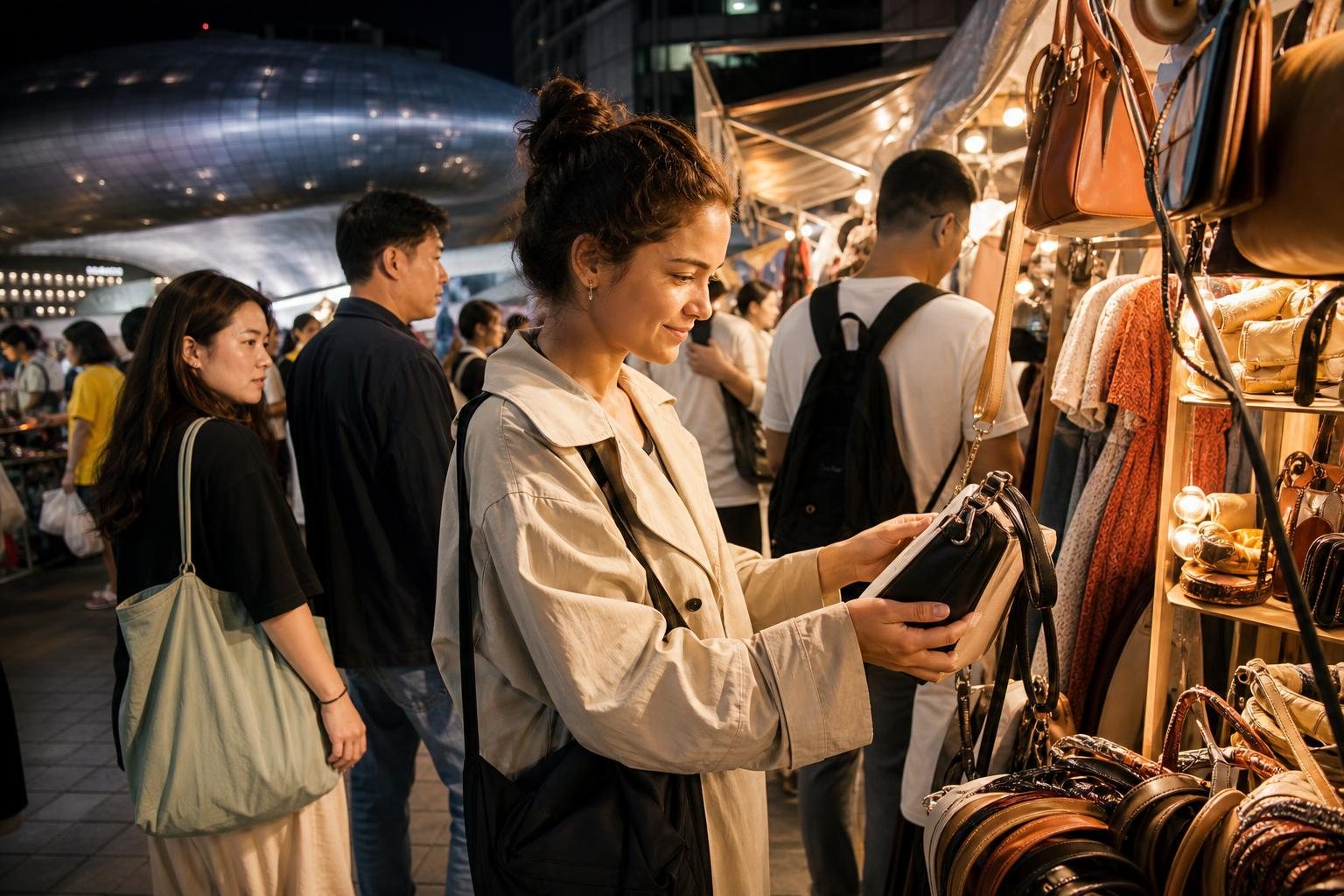
  • Dongdaemun Night Shopping Guide: Areas, Transport, and Payment Tips

    Dongdaemun Night Shopping Guide: Areas, Transport, and Payment Tips

    Dongdaemun night shopping is not one market with one shared schedule. It is a large shopping district with fashion buildings, wholesale-oriented shops, traditional-market sections, specialist material stores, and outdoor stalls. The easiest way to enjoy it is to choose one goal first—trend fashion, accessories, fabric, or casual browsing—then navigate to the specific building or area.

    For many visitors, Dongdaemun History & Culture Park Station is the most convenient starting point for the fashion-focused side near Dongdaemun Design Plaza (DDP). For fabric and craft materials, Dongdaemun Shopping Complex and the older market side are usually a better fit. Check the current details for your exact destination before leaving, because opening arrangements, rest days, and payment methods vary by building and shop.

    Understand Dongdaemun before you go

    Think of Dongdaemun as a shopping neighborhood rather than a single mall. Seoul’s official tourism guide describes Dongdaemun Market as a large commercial district around Dongdaemun Gate, while the Korea Tourism Organization highlights its mix of traditional market shopping and modern retail complexes.

    The experience can change quickly from one building to the next. One may focus on ready-to-wear clothing, another on business buyers ordering stock, and another on fabric, trims, or DIY supplies. Outdoor stalls offer a more informal browsing experience.

    • Fashion buildings are useful for clothing, shoes, bags, and accessories.
    • Wholesale-oriented stores may have a faster, less service-focused shopping style.
    • Specialist market sections are better for materials, sewing supplies, and custom projects.
    • Outdoor stalls are best approached as discovery shopping, not as a guaranteed source for one exact item.

    Main Dongdaemun shopping areas

    Dongdaemun History & Culture Park and DDP side

    This is an easy starting zone for first-time visitors. It is close to major fashion buildings, DDP, and streets associated with the district’s evening shopping atmosphere. DDP is also a practical landmark for meeting companions and getting oriented.

    Choose this side if you want trend-focused fashion, indoor shopping buildings, street browsing, and a straightforward navigation point. The Korea Tourism Organization identifies DDP as one of Dongdaemun’s defining landmarks.

    The fashion mall cluster

    Large multi-floor buildings around central Dongdaemun sell clothing, footwear, bags, accessories, beauty items, and lifestyle goods. Although the buildings can look similar from outside, individual stores may serve very different customers. Some welcome single-item retail purchases, while others operate mainly with wholesale buyers in mind.

    The Korea Tourism Organization notes that Dongdaemun includes wholesale clothing buildings as well as specialist outlets. Browse with a simple comparison process:

    1. Walk through a full floor before buying the first item you like.
    2. Photograph the shop sign, floor, and unit number when you find a promising item.
    3. Ask whether your preferred size or color is available.
    4. Confirm the final total and payment method before the item is packed.
    5. Keep a receipt or transaction record until you have checked the purchase.

    Dongdaemun Shopping Complex for fabric and DIY supplies

    If you need materials rather than finished clothing, start with Dongdaemun Shopping Complex. Official tourism information lists fabric, garment-making materials, accessories, traditional clothing-related goods, bedding, curtains, and craft components among its product categories.

    This area is especially useful for fabric by length, buttons, zippers, ribbons, patches, jewelry-making parts, sewing materials, and hanbok-related fabrics or accessories. The layout can feel maze-like, so note the shop number when you find a store you may want to revisit.

    A useful phrase: “Can I take a photo of the shop number?”

    Outdoor tented stalls near DDP

    The outdoor stalls near DDP are widely known as the Yellow Tent Market. Official tourism information refers to this area as Dongdaemun Sebit Market and associates it with tented stalls selling items such as clothing, bags, and accessories.

    Selection can change quickly, so browse with flexibility. Before paying, inspect seams, zippers, lining, fasteners, and both sides of garments or bags. Ask about exchanges for defects, check whether you are receiving a display sample or a new item, and confirm the accepted payment method.

    How to check opening arrangements

    A common mistake is treating a search for “Dongdaemun opening hours” as an answer for the whole district. It is not. Individual malls, market sections, floors, and shops can follow different operating arrangements and rest days.

    Check the exact destination

    Before you leave, identify whether you are going to a fashion mall, Dongdaemun Shopping Complex, a specific store, an outdoor stall area, or a restaurant inside a building. Check that destination’s official channel, current map listing, or entrance notice. If one building is closed, another part of the district may still be active.

    Make a flexible route

    • Plan A: your priority building or shop
    • Plan B: a nearby fashion building or market street
    • Plan C: DDP, a café, or a walk through the area while you choose another destination

    Use older blog posts to understand the character of an area, but do not rely on them as final confirmation for a specific shop’s current schedule.

    Getting to Dongdaemun

    Use Dongdaemun History & Culture Park Station for the fashion side

    This station is a useful main pin for DDP and many fashion-oriented shopping buildings. Seoul’s official tourism guide identifies it as a convenient access point for Dongdaemun Market.

    In a map or navigation app, search for a specific destination instead of only searching “Dongdaemun.” Useful search terms include:

    • Dongdaemun History & Culture Park Station
    • Dongdaemun Design Plaza
    • Dongdaemun Shopping Complex
    • The exact name of your target mall or shop

    Use Dongdaemun Station for the older market side

    Dongdaemun Station can be more convenient for Dongdaemun Shopping Complex and nearby traditional-market areas. The Korea Tourism Organization lists the complex near this station.

    Navigation tips

    • Save your accommodation address in both Korean and English.
    • Save a map pin or route screenshots before leaving.
    • Use the building name, not only the neighborhood name, if taking a taxi.
    • Check the exit number in your map app and compare it with station signs.
    • Allow extra time for large road crossings and for finding the correct building entrance.

    Payment tips for foreign visitors

    Payment practices vary across Dongdaemun. Larger malls may have more standardized checkout systems, while smaller shops and outdoor stalls may handle payment differently. Do not assume that a foreign-issued card, contactless payment, mobile payment, or cash will be accepted by every seller.

    Ask before committing to a purchase

    Before trying on an item, taking it to the counter, or asking staff to pack it, use short questions:

    • “Card okay?”
    • “Cash only?”
    • “Can I pay by foreign card?”
    • “Can I pay by mobile payment?”

    Bring a backup option

    A practical setup is one physical card, a backup card stored separately, a small amount of Korean cash, and a payment app only if you already know it works on your device. The point is not to use one method everywhere; it is to avoid being unable to complete a purchase.

    Confirm the total and exchange policy

    For small independent shops, especially where prices are not clearly marked, confirm the total before paying. If you are buying several pieces, point to each item while the seller calculates. Seoul tourism information notes that fixed or displayed pricing has become more common in parts of the district, so do not assume bargaining is expected.

    Ask about returns or exchanges before payment. Exchange options may be limited for clothing, accessories, sale items, or purchases from small shops. If the answer is unclear, inspect the item carefully before paying.

    A useful phrase: “Exchange possible if there is a problem?”

    Simple shopping plans

    For trend fashion

    1. Arrive at Dongdaemun History & Culture Park Station.
    2. Choose one or two fashion buildings instead of trying to see everything.
    3. Browse a full floor before deciding.
    4. Photograph shop locations for comparison.
    5. Finish with outdoor stalls if you still want to browse.

    For fabric, accessories, or DIY materials

    1. Start at Dongdaemun Shopping Complex.
    2. Write down the material, color, quantity, or item type you need.
    3. Compare several shops before buying.
    4. Confirm how the material is measured or packaged.
    5. Keep small purchases organized if you buy components from several shops.

    For casual evening browsing

    1. Use DDP as a meeting point.
    2. Walk through the nearby fashion-mall streets.
    3. Browse tented stalls if they are operating.
    4. Buy an item because you genuinely want it, not only because the area feels exciting.

    Common mistakes to avoid

    • Trying to see everything: Pick one main purpose and one backup area.
    • Confusing wholesale with regular retail: A store may sell to individuals but still be organized for business buyers.
    • Forgetting where you saw an item: Save photos of signs, floor numbers, and unit numbers.
    • Paying before inspecting: Check for marks, missing parts, loose stitching, scratches, and mismatched sizes.
    • Relying on one payment method: Carry a backup and ask before the item is packaged.

    FAQ

    Is Dongdaemun night shopping suitable for first-time visitors to Seoul?

    Yes. Treat it as a neighborhood with several shopping zones, not one destination. Start near Dongdaemun History & Culture Park Station or DDP, choose one shopping goal, and keep a backup destination in mind.

    What is the best area for fabric and craft supplies?

    Dongdaemun Shopping Complex is a strong starting point for fabric, garment materials, accessories, and DIY components. Official tourism information lists fabrics, clothing materials, bedding, curtains, and accessories among its main categories.

    Is the Yellow Tent Market the same as Dongdaemun?

    No. It is one part of the wider Dongdaemun shopping district. It is commonly associated with Dongdaemun Sebit Market and outdoor tented stalls near the DDP area.

    Can I use a foreign credit card in Dongdaemun?

    Some businesses may accept cards, but accepted methods differ by building and seller. Ask before shopping, bring a backup payment option, and confirm the method before the item is packed.

    Should I bargain in Dongdaemun?

    Do not assume bargaining is expected. Prices may be displayed or treated as fixed in many stores. If you are buying multiple items, you can politely ask whether there is flexibility, then accept the answer without pressure.

    What should I save on my phone before going?

    Save the name of your target building, a map pin, your accommodation address, and photos of shop locations you may want to revisit. These small preparations make navigation much easier among similar-looking entrances and floors.

    Sources

    Related articles

    Information current as of: 2026-09-07

  • Dongmyo Flea Market Guide: What to Buy, How to Bargain, and How to Shop Smart

    Dongmyo Flea Market Guide: What to Buy, How to Bargain, and How to Shop Smart

    Dongmyo Flea Market is best for patient treasure hunting rather than quick, polished shopping. Go with one or two item types in mind—such as vintage clothing, records, old books, cameras, tools, or unusual home objects—but leave room for unexpected finds. A smart approach is to walk through the area once without buying, compare similar items, and then return to the stalls that stood out.

    The market is a good fit if you enjoy searching through mixed second-hand goods and judging condition for yourself. For the best experience, inspect every item carefully, bargain calmly only when appropriate, and buy only what you can comfortably carry home.

    What makes Dongmyo Flea Market different?

    Dongmyo Flea Market is a second-hand shopping area in Jongno, Seoul, near Dongmyo Station. Unlike a curated vintage store, it is known for an unpredictable assortment of used goods. Seoul tourism information describes items including antiques, old books, records, cameras, clocks, jewelry, machines, tools, furniture, and household objects.

    That unpredictability is part of the appeal. You might find something memorable within minutes, or spend a long time looking through racks and boxes without finding the right item. Treat the visit as a browsing experience first and a shopping mission second.

    Seoul Metropolitan Government: Dongmyo Flea Market

    What to buy at Dongmyo

    Vintage clothing

    Dongmyo is widely associated with second-hand clothing. You may come across shirts, jackets, knitwear, workwear-inspired pieces, caps, and garments with an older Seoul street-market character.

    • Check for thinning fabric, stains, odors, loose seams, and missing buttons.
    • Look closely at cuffs, collars, underarms, pockets, and linings.
    • Do not rely only on the size label. Older and imported clothing can fit differently from current sizing.
    • If trying an item on is not possible, hold it against yourself or compare its measurements with clothing you already own.
    • Ask before unfolding tightly packed displays or removing items from hangers.

    Buying tip: Choose a garment because its fit and condition work for you, not simply because it looks vintage.

    Records, books, cameras, and collectibles

    Dongmyo can reward visitors who enjoy physical media and objects with a history. Official Seoul information specifically includes old books, records, cameras, tools, and other collected items among the goods found in the area.

    • Records: Look for warping, deep scratches, mold, and damaged sleeves.
    • Books and magazines: Check for missing pages, water damage, heavy yellowing, and writing inside.
    • Cameras: Treat untested film or electronic cameras as display pieces unless key functions can be demonstrated.
    • Watches and electronics: Assume repairs may be needed unless you can inspect and test them carefully.
    • Decorative antiques: Check for cracks, repairs, loose parts, and signs that an item may be a reproduction.

    If authenticity, working condition, or collectibility matters a great deal, use Dongmyo mainly for browsing, comparing, and asking questions rather than making an immediate impulse purchase.

    Seoul Metropolitan Government: Dongmyo Flea Market information

    Homeware, tools, and unexpected objects

    Part of Dongmyo’s charm is finding objects that are difficult to find in modern chain stores: old kitchenware, frames, containers, lighting, small furniture, hardware, figurines, and everyday objects from another era. Nearby vintage and antique shops also carry furniture, lighting, industrial-style objects, and LP records from Korea and abroad.

    These can be especially appealing for residents who can transport items safely. If you are visiting Seoul, think about luggage space, fragility, and whether the item will travel well before buying it.

    Visit Seoul: Manmulsangdan Dongmyo Vintage Antique Shop

    How to bargain without making it awkward

    Bargaining works best when it is calm, brief, and respectful. It is not expected at every stall, and some sellers may prefer to keep the stated price.

    1. Inspect the item first. Do not negotiate before deciding that you genuinely want it.
    2. Ask for the price clearly. If there is no label, point politely and ask.
    3. Set your own limit. Decide the maximum you are comfortable paying before the conversation starts.
    4. Make one reasonable counteroffer. A modest request is generally better than an extreme low offer.
    5. Accept the answer gracefully. If the seller declines, either buy at the stated price or thank them and move on.

    Useful Korean phrases

    • 얼마예요? (Eolmayeyo?) — How much is it?
    • 조금 깎아 주실 수 있어요? (Jogeum kkakka jusil su isseoyo?) — Could you lower it a little?
    • 이걸로 할게요. (I geollo halgeyo.) — I’ll take this.
    • 감사합니다. (Gamsahamnida.) — Thank you.

    You do not need perfect Korean. A polite tone, clear gestures, and patience are more useful than memorizing many phrases.

    Bargaining mistakes to avoid

    • Do not negotiate aggressively over a low-cost item.
    • Do not ask for a discount after the seller has packed the item.
    • Do not describe an item as worthless simply to lower the price.
    • Do not compare every item with online resale listings in front of the seller.
    • Do not assume that a discount is expected.

    When to visit: choose your goal

    There is no single best moment for every visitor. The experience can change with crowd levels, weather, vendor setup, and whatever items happen to be available. Instead of chasing a perfect time, plan around the kind of visit you want.

    For more focused shopping

    Allow enough time for a full first pass before you purchase anything. Seeing several stalls helps you understand the range and condition of similar items, reducing the chance of buying the first thing you see.

    For slower browsing

    Do not schedule the visit immediately before another reservation or attraction. Dongmyo rewards wandering, and interesting items can be mixed into crowded racks, stacked shelves, and tables that need careful searching.

    For a more comfortable conversation

    If you want to ask about an item or make a counteroffer, speak with the seller when they are not helping several customers at once. A short, direct conversation is usually easier than trying to negotiate in a crowd.

    For photography and atmosphere

    Ask before taking close-up photographs of vendors, merchandise, or transactions. Dongmyo is a working market for sellers, not only a backdrop for social media.

    A practical Dongmyo shopping plan

    1. Start with a short wish list

    Choose no more than two categories. For example:

    • A vintage jacket
    • A Korean-language magazine or old book
    • A record
    • A compact home object
    • A small souvenir with character

    A short list gives your visit some focus while leaving room for spontaneous finds.

    2. Do a no-buy first lap

    Use your first walk to notice which stalls seem to focus on clothing, media, tools, or antiques. Compare the general condition of similar items, see whether your category appears in several places, and note vendors who seem knowledgeable about a particular type of object.

    3. Inspect before you negotiate

    Condition matters more than appearance. A faded label may add character, but a broken zipper, severe mildew smell, missing component, or warped record may make an item a poor choice.

    4. Buy what you can carry

    For travelers, compact and durable purchases are often easiest: a cap, scarf, shirt, small print, book, postcard-sized artwork, or lightweight record sleeve. Large furniture, fragile goods, and untested electronics require more planning.

    5. Keep expectations flexible

    Dongmyo is not the place to demand a specific brand, color, size, or collectible model. If you need an exact item in reliable condition, a specialist shop may be a better match. If you enjoy the search itself, Dongmyo can be much more memorable.

    Dongmyo Flea Market vs. curated vintage shops

    Choose Dongmyo if you enjoy digging through mixed racks, discovering unexpected records or books, and assessing an item’s condition on your own. It is also a good choice for unusual souvenirs and one-of-a-kind home objects.

    Choose a curated vintage shop if you want sorted sizes, clearer presentation, a particular title or genre, more consistent condition information, or specialist guidance about provenance and restoration.

    Important things to remember

    • Inventory changes constantly, so avoid planning around one exact item.
    • Used goods can have wear, repairs, odors, missing parts, or unknown histories.
    • Check clothing, media, and mechanical items carefully before paying.
    • Payment methods and purchase conditions can vary by stall, so confirm directly with the seller.
    • If you are unsure, walk away and return after another lap. Extra thinking time often leads to a better decision.

    FAQ

    Is Dongmyo Flea Market good for first-time visitors to Seoul?

    Yes, especially for visitors who enjoy second-hand shopping, vintage fashion, old media, and street-market atmosphere. It is less suitable for people looking for a polished, mall-like shopping experience.

    Can I find authentic vintage items?

    You may find genuinely old and interesting pieces, but authenticity and condition vary. Inspect carefully and do not assume that every old-looking item is rare or collectible.

    Is bargaining required?

    No. You can ask politely, but a seller may keep the original price. Decide based on the condition of the item and how much you personally want it.

    What is the safest type of item to buy?

    Clothing and small decorative objects are often easier to inspect than complex electronics or mechanical items. Whatever you buy, check its condition closely before paying.

    Is Dongmyo only for clothes?

    No. Official tourism information describes a broader selection that can include antiques, records, books, cameras, tools, furniture, household goods, and collectible objects.

    Related articles

    Information current as of: 2026-09-06

    Sources and references

  • E-9 Korea Visa Guide: EPS Eligibility, Application Steps, and Workplace Rules

    E-9 Korea Visa Guide: EPS Eligibility, Application Steps, and Workplace Rules

    The E-9 visa is Korea’s Non-Professional Employment visa for foreign workers hired through the government-run Employment Permit System (EPS). For a first-time applicant, the usual route is not finding a job online and applying independently. You normally enter an EPS selection process in your sending country, pass the required stages, register as a job seeker, receive selection from an eligible Korean employer, sign the standard contract, and complete the visa process before entry.

    Passing a Korean-language test does not guarantee an E-9 visa or a job in Korea. Employer selection, the employment permit process, immigration approval, and embassy visa issuance must still be completed. Current rules can differ by sending country, recruitment round, industry, quota, and individual immigration history.

    What is the E-9 visa?

    E-9 is the visa category used for non-professional foreign employment under Korea’s EPS. The system allows eligible Korean employers that cannot fill positions with domestic workers to hire foreign workers through a regulated process. The Ministry of Employment and Labor provides an overview of the EPS framework at its official international employment policy page.

    E-9 employment is commonly connected with EPS-approved work in manufacturing, construction, agriculture and livestock, fishing, and certain policy-designated service sectors. The available sectors, business requirements, and recruitment volume are not identical for every country or recruitment round.

    • You are hired for a specific authorized workplace.
    • The Korean employer must qualify to hire an E-9 worker.
    • Your job and workplace cannot normally be changed freely.
    • Your employment is governed by both labor rules and immigration rules.

    Who is eligible for an E-9 visa?

    Applicants generally use an EPS sending-country route

    For first-time applicants, the standard path begins through the authorized EPS process in a participating sending country. The worker process described by HRD Korea’s EPS guidance includes Korean-language testing and related selection stages, health screening, and job-seeker registration for eligible candidates.

    The exact age criteria, test requirements, health standards, skills assessments, and re-entry rules must be checked in the current recruitment notice for your country. Do not rely on a social-media post that presents one universal rule for every E-9 applicant.

    The employer must qualify too

    An employer cannot simply invite any worker under E-9. Under the EPS process, an employer generally registers a domestic recruitment request first. If the needed local workers cannot be hired and other requirements are met, the employer may apply for an employment permit and select a worker through EPS. See the official employer-side EPS process for the current framework.

    Application conditions and documents

    The E-9 route has two connected parts: the Korean employer’s authorization process and the worker’s visa application through the Korean embassy or consulate.

    Employer-side documents and conditions

    After the worker is selected and the standard employment contract is finalized, the employer or an authorized representative generally applies for a Visa Issuance Confirmation. Official EPS guidance lists documents that may include:

    • Visa Issuance Confirmation application;
    • Employment permit;
    • Standard employment contract;
    • Business registration and workplace-related documents; and
    • Any additional documents requested by immigration authorities.

    Documents the worker may need

    After the Visa Issuance Confirmation is available, the worker normally follows the sending-country procedure to apply for an E-9 visa at the Korean embassy or consulate. A current embassy checklist may require:

    • A valid passport;
    • A visa application form and passport photograph;
    • A Visa Issuance Confirmation number or related approval document;
    • Employment documents provided through the EPS process; and
    • Additional documents requested for the individual case.

    The Korea Visa Portal notes that visa authorities may request additional documents or waive documents depending on the case. Use the current instructions from the embassy or consulate where you will apply; a checklist from another country may not apply to you.

    E-9 visa process: step by step

    1. Check the official EPS recruitment notice in your home country. Confirm whether recruitment is open, which occupations are available, and the eligibility rules for that round.
    2. Complete the required language test and selection stages. Follow the locally announced EPS process rather than assuming a test score alone is enough.
    3. Complete health screening and job-seeker registration. Candidates who meet the applicable requirements may be placed on the job-seeker roster transmitted through the sending-country process to HRD Korea.
    4. Be selected by an eligible Korean employer. An employer that has obtained an employment permit can review referred candidates and select a worker through EPS.
    5. Review and confirm the standard employment contract. Check the workplace address, job type, contract period, wages, hours, accommodation terms, and any stated deductions before you confirm the contract.
    6. Complete the Visa Issuance Confirmation and embassy visa process. The employer-side immigration process comes first, followed by the worker’s visa application as instructed by the authorized sending institution and Korean embassy or consulate.
    7. Enter Korea and complete post-arrival procedures. The EPS arrival guidance describes employment education after entry, including a 16-hour program, followed by required procedures and workplace assignment. See HRD Korea’s arrival-to-departure guidance.

    The Korea Visa Portal states that a Visa Issuance Confirmation is generally valid for three months and for one visa issuance. Confirm the validity period shown on your own approval before making travel plans.

    Fees and processing time

    There is no single official total cost or guaranteed processing period that applies to every E-9 worker. The timeline can depend on the EPS recruitment calendar, testing dates, health screening, time on the job-seeker roster, employer selection, immigration review, embassy appointment availability, and entry scheduling.

    Possible expenses may include authorized test fees, medical examination fees, document preparation, visa fees, travel, insurance, and other country-specific program charges. Request a current itemized amount from the authorized EPS institution in your country and the Korean embassy or consulate before paying.

    Do not use old blog posts, private-agent price lists, or promises of a “guaranteed E-9 placement” as an official fee schedule or application route.

    Important rules and common mistakes

    Do not change workplaces without using the formal process

    E-9 employment is linked to an authorized workplace. EPS guidance explains that workplace changes are limited to specific circumstances, such as business closure, suspension of operations, or justified termination by the employer. If there is a serious workplace problem, do not simply stop working or begin work elsewhere. Use the formal EPS, employment-center, and immigration procedures first.

    Understand the employment-period limit

    The Act on the Employment of Foreign Workers provides that foreign workers may generally engage in employment activities for up to three years from entry. In specified re-employment cases, it provides for one extension of less than two years when statutory conditions are met, including the required employer request before departure.

    This is often described as a possible total of up to four years and ten months. It is not automatic. Confirm your own eligibility through the current EPS and immigration process.

    Keep records and check deductions

    Keep copies of your passport and residence documents, employment contract, payslips, workplace address, employer contact information, accident records, and written notices about contract changes or dismissal. If you do not understand a deduction for accommodation, meals, insurance, taxes, or another item, ask for a written explanation and compare it with your contract and payslip.

    Know that labor protections still apply

    EPS guidance states that E-9 workers are protected by Korean labor laws, including the Labor Standards Act, Minimum Wage Act, and Occupational Safety and Health Act. Preserve evidence if you face unpaid wages, violence, unsafe work, passport confiscation, or pressure to work outside the authorized arrangement.

    E-9 compared with other Korean stay categories

    E-9 Non-Professional Employment

    This is the EPS-based route for permitted non-professional work. It generally involves overseas recruitment, employer selection, and restricted workplace mobility.

    H-2 Work and Visit

    H-2 is for eligible overseas Koreans and follows a different employment route. The official H-2 employment process describes job registration and matching procedures distinct from the standard E-9 overseas recruitment system.

    E-7 Specially Designated Activities

    E-7 is generally based on a different occupation, qualification, and employer-sponsorship framework. It should not be treated as an automatic upgrade from E-9.

    E-8 Seasonal Work

    E-8 is intended for seasonal work arrangements in designated sectors, not the standard EPS non-professional employment route.

    D-2 or D-4 study and training status

    Student and training categories are not general work visas. Any work activity is subject to separate restrictions and requirements.

    Frequently asked questions

    Can I apply for an E-9 visa by myself while I am in Korea?

    For a first-time E-9 applicant, the standard route is the EPS sending-country process, employer selection, and visa procedure before entry. Do not assume that visitor, student, or short-term status in Korea can be changed to E-9 from inside Korea.

    Can I get an E-9 visa without passing the Korean-language test?

    The official EPS worker process includes Korean-language testing and related selection procedures. The precise requirement depends on the current recruitment notice and sending-country program, so check the official announcement for your country.

    Does passing EPS-TOPIK guarantee a job in Korea?

    No. Passing a required test can allow you to move to later stages, but you must still be placed on the job-seeker roster, selected by an eligible employer, complete the contract process, and receive immigration and visa approval.

    Can I choose any employer after arriving in Korea?

    No. E-9 work is connected to the authorized workplace and employment arrangement. Workplace changes are restricted and must be handled through the official process.

    How long can I stay on E-9?

    The general employment-activity period is up to three years from entry. A one-time extension of less than two years may be possible in specified re-employment cases, but individual eligibility must be confirmed under current EPS and immigration rules.

    Final checklist before you act

    • Check the live EPS recruitment notice for your nationality and occupation.
    • Confirm current test, health-screening, and registration requirements.
    • Read the standard employment contract before confirming it.
    • Use only authorized EPS and embassy channels for fees and documents.
    • Confirm embassy-specific visa requirements and appointment procedures.
    • Do not pay anyone who claims to guarantee a roster place, job selection, or visa approval.

    Related Korea visa guides

    Professional immigration help

    If you need help checking your Korean visa eligibility or preparing an immigration application, Darum Administrative Office is a Ministry of Justice-registered immigration application agency.

    Immigration & Visa Consultation →

    Information current as of: 2026-09-05

    Sources and references