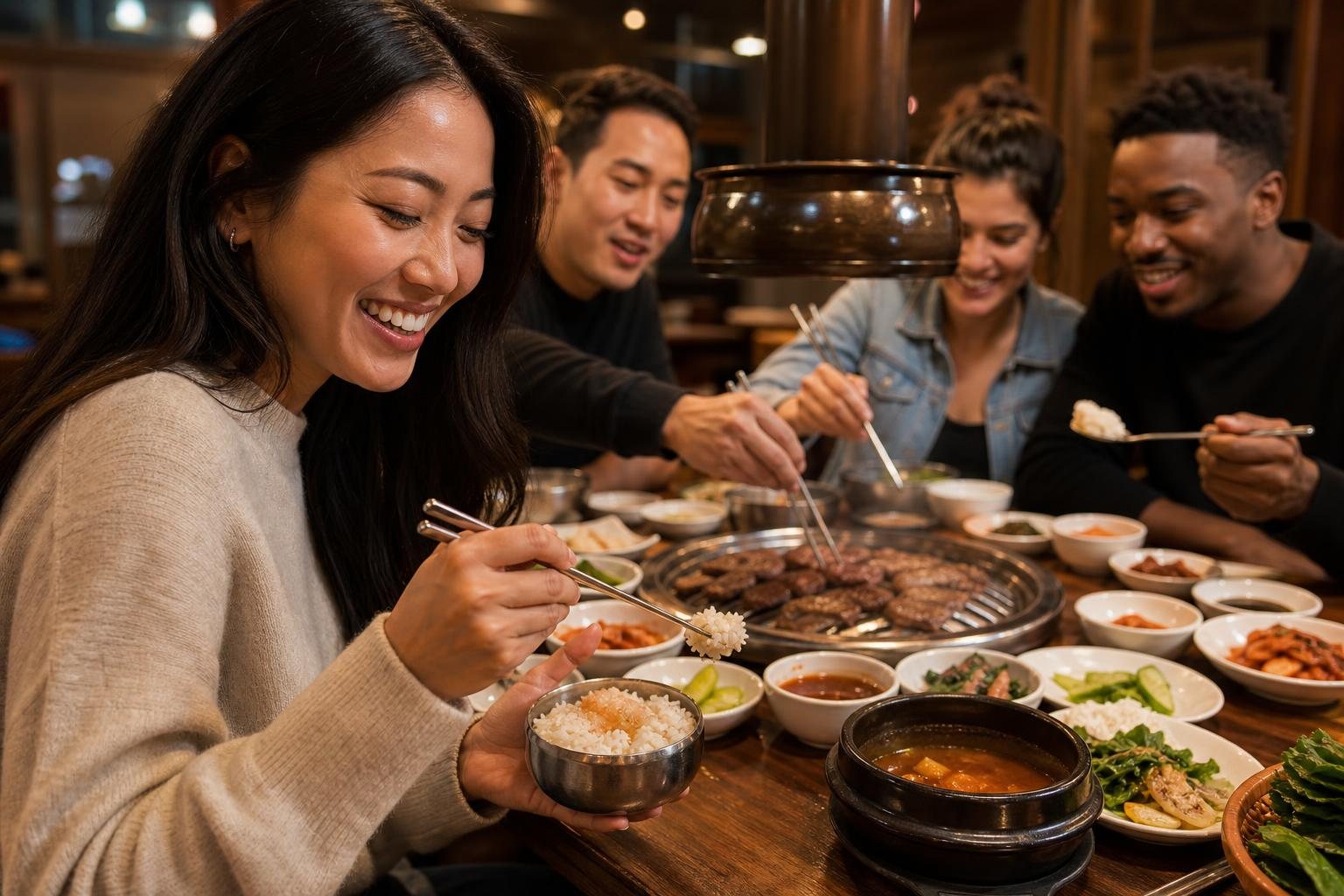
The key rules are simple: use a spoon for rice and soup, use chopsticks for meat and side dishes, and keep your rice and soup bowls on the table. When dishes are shared, take a modest portion and follow the pace of the people dining with you.
If you are eating with older Koreans, wait for the eldest person to begin before you start. You do not need perfect chopstick skills or formal manners to enjoy the meal; considerate behavior matters more than performing every custom perfectly.
The etiquette that matters most
Korean restaurant meals can be relaxed, especially among friends, but a few habits are useful almost everywhere. Korean meals commonly include both a spoon and chopsticks, so using a spoon is normal—not a failure of chopstick technique. VISITKOREA and Visit Seoul describe these basic dining customs.
- Use a spoon for rice, soup, stew, and other soft foods.
- Use chopsticks for meat, vegetables, noodles, and side dishes.
- Keep rice and soup bowls on the table rather than lifting them.
- Take shared food carefully and avoid taking more than you will eat.
- When dining with an older person, wait for them to begin.
Understand the place setting
A typical meal may include rice, soup or stew, a main dish, and several small shared side dishes called banchan. A rice-and-soup meal served with multiple side dishes is often called baekban. VISITKOREA’s guide to baekban explains this style of set meal.
What each utensil is for
- Spoon: rice, soup, stew, and bibimbap.
- Chopsticks: grilled meat, vegetables, noodles, and banchan.
- Kitchen scissors: cutting large pieces of grilled meat, kimchi, or noodles when they are provided at the table.
- Tongs: handling raw meat at Korean barbecue.
A helpful rule for beginners is: spoon for rice and liquid dishes, chopsticks for solid foods. Traditional etiquette also advises against holding both spoon and chopsticks in one hand while eating. FACTS: KOREA outlines this utensil custom.
Five rules to remember
1. Keep bowls on the table
In Korean dining etiquette, rice and soup bowls generally stay on the table. Scoop rice with your spoon instead of lifting the bowl toward your mouth. If you forget once, do not worry—simply continue naturally.
2. Never stand chopsticks upright in rice
Do not leave chopsticks or a spoon standing vertically in a bowl of rice. This resembles food offerings connected with memorial or funeral rites. Put utensils on the table, a utensil rest, or the place provided by the restaurant. Visit Seoul lists this as an etiquette point to avoid.
3. Let an older diner begin first
With relatives, colleagues, teachers, or older acquaintances, wait until the eldest person starts eating. At a casual meal with friends of a similar age, follow the table’s natural pace instead of waiting for a formal signal.
4. Take shared dishes with care
Banchan is usually placed in the middle for everyone. Take a small, reasonable amount at first. Use serving spoons, tongs, or separate chopsticks when they are available. If none are provided, observe the group and avoid double-dipping.
5. Keep utensil use calm
Avoid banging metal chopsticks on bowls, waving them around, or using them to spear food when another utensil works. These details are less important than being considerate, but they help make a shared table more comfortable.
Korean barbecue: a practical approach
Korean barbecue is interactive: meat, a grill, sauces, lettuce leaves, side dishes, tongs, and sometimes scissors may all be on the table. There is no single rule about who cooks. In some restaurants, staff grill or assist and tell diners when the meat is ready. VISITKOREA notes that staff service is available at some barbecue restaurants.
If your group is cooking
- Use the provided tongs for raw meat.
- Do not overcrowd the grill.
- Cut large pieces with the scissors only when that is how the table is set up.
- Keep cooked meat separate from raw meat where practical.
- Let the most experienced diner lead at first, or ask staff for help.
Making a lettuce wrap
A ssam is a lettuce or perilla-leaf wrap, often filled with grilled meat, rice, sauce, or kimchi. It is traditionally eaten in one bite, so make it small enough to manage neatly. A smaller wrap is completely fine and is usually easier for first-time visitors.
Restaurant habits that may surprise you
Side-dish refills
Many restaurants serve banchan with the meal, and extra water or side dishes may be available at no extra charge. However, refill rules vary by restaurant; some have self-service stations, limits, or exclusions for certain items. Check a table sign, look for a self-service area, or ask staff before assuming a refill is available.
Call bells and utensil drawers
Some tables have a service call button built into the tabletop or near the wall. Press it once when you need assistance. Spoons, chopsticks, napkins, and tissues may also be stored in a drawer under the table. These arrangements are common but not universal. VISITKOREA describes both call bells and table drawers in Korean dining settings.
Tipping
Tipping is generally not customary in ordinary Korean restaurants. Visit Seoul notes that tipping is not customary, while VISITKOREA explains that common service requests such as water or side dishes generally do not bring an extra charge. Pay the listed total unless a service charge is clearly shown on the bill.
A simple first-visit checklist
- Follow the staff’s seating instructions and check how the restaurant handles ordering.
- Look for utensils in a table drawer if they are not already on the table.
- Wait briefly for an older diner to begin if you are eating with one.
- Use your spoon for rice and soup; use chopsticks for meat and banchan.
- Take small portions from shared dishes before taking more.
- At barbecue, use tongs for raw meat and ask for help if you are unsure.
- Check whether payment is made at the table or at a counter near the exit.
Common mistakes to avoid
- Lifting the rice bowl: leave it on the table and use your spoon.
- Sticking chopsticks into rice: rest them flat instead.
- Taking too much banchan: shared dishes are for the whole table, so start small.
- Assuming every restaurant has the same system: ordering, water, refills, grilling, and payment practices differ by venue.
- Forcing yourself to finish unfamiliar food: avoid waste, but take small tastes first—especially with spicy, fermented, or salted dishes.
The goal is not to copy every movement of local diners. Use the spoon and chopsticks in the usual way, share thoughtfully, and follow the restaurant’s setup.
Useful Korean dining phrases
- 잘 먹겠습니다 (jal meokgesseumnida): “I will enjoy the meal.”
- 잘 먹었습니다 (jal meogeosseumnida): “Thank you, I enjoyed the meal.”
- 여기요 (yeogiyo): “Excuse me / Over here, please.”
- 물 주세요 (mul juseyo): “Water, please.”
- 이거 더 주세요 (igeo deo juseyo): “More of this, please.”
- 계산할게요 (gyesanhalkkeyo): “I’d like to pay.”
FAQ
Is it rude to ask for a fork?
No. Many restaurants can provide one, particularly in tourist areas and modern casual restaurants. Still, use the spoon for rice and soup first; it is a standard Korean utensil.
Can I eat banchan in any order?
Yes. Korean meals are meant to be combined according to your taste. Try rice with different side dishes, soup, meat, and sauces as you like.
Must I eat a lettuce wrap in one bite?
That is the traditional approach, but do not make a wrap so large that it is difficult to eat. A small, neat ssam is a better choice.
Should I use two hands when receiving a drink or dish?
Using two hands is a polite gesture, especially with an older person or in a formal work or family meal. At a relaxed meal with friends, ordinary behavior is usually fine.
Can I eat alone at a Korean restaurant?
Often, yes. However, some barbecue and group-oriented restaurants may have minimum orders or may be less convenient for solo diners. Check the menu or ask the restaurant before ordering.
Final takeaway
For a first Korean restaurant visit, remember: spoon for rice and soup, chopsticks for side dishes, bowls stay on the table, and shared food deserves shared consideration. Follow the people at your table and the restaurant’s own system, and you will be well prepared.
Related articles
- How to Use a Korean Café Kiosk Without Speaking Korean
- Eating Alone at a Korean Traditional Market
- How to Pay in Korea: Foreign Cards, Cash and Mobile Payments
Information current as of: 2026-09-01
답글 남기기