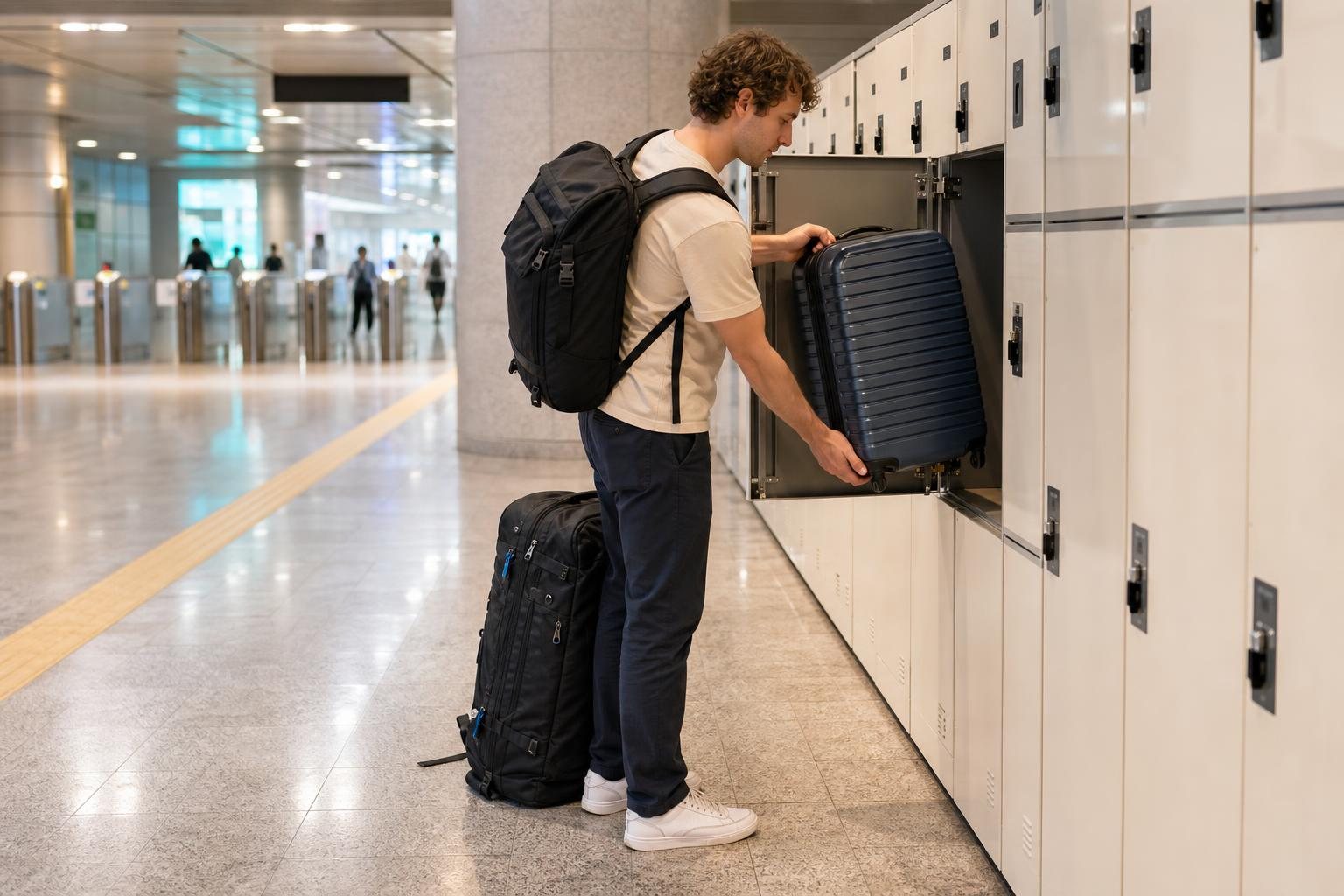
Korean station “coin lockers” are usually electronic self-service luggage lockers rather than old machines that accept coins only. At a subway or train station, choose an empty locker, follow the screen instructions, pay using an accepted method, close the door, and keep the locker number and retrieval details.
The key is to check the locker’s location, size, payment options, and pickup hours before you store your bag. Rules and prices vary by station and operator, so do not assume that cash, a foreign credit card, a transport card, or a particular app will work everywhere.
Find a locker at the right place
Look for signs such as 물품보관함 (mulpum bogwanham, luggage/storage locker), 보관함 (bogwanham, locker), or 짐보관 (jim bogwan, luggage storage). Locker banks may be near exits, concourses, transfer passages, waiting areas, or ticket gates.
At Korail and KTX stations, check the station facilities information or ask at the information desk. Korail station pages list locker facilities at selected stations, but the exact location and availability are station-specific. Korail station information
Choose the correct side of the gates
- If you will leave the station to sightsee, a locker in the public concourse or near an exit is usually easiest.
- If a locker is inside the paid subway area, you may need to pass through the gates again to collect your luggage.
- At a large station, take a photo of the locker bank and a nearby exit sign. Stations can have several buildings, concourses, and exits.
This prevents a common mistake: leaving a bag in a locker that is inconvenient or impossible to reach when you return.
How to use a Korean station locker
- Check the size. Open the door and make sure your bag fits without forcing it. A rigid suitcase may need more room than its label suggests.
- Start on the touchscreen. Select an option such as Store, Deposit, or Keep Luggage. The wording differs by operator.
- Choose a locker and review the fee. Confirm the starting period, extra-time charges, maximum storage period, and payment methods shown on that machine.
- Pay using an accepted method. Depending on the operator, options may include a transportation card, Korean payment card, cash, QR-based payment, or another displayed method.
- Place your belongings inside and close the door firmly.
- Save the retrieval information immediately. This may be a locker number, PIN, receipt code, QR code, transportation card, or app record.
Many lockers have multilingual instructions, but language and payment support are not identical at every location. The Korea Tourism Organization notes that lockers are common at subway stations and that the available payment and operating methods vary. VISITKOREA subway guide
Do not rely on memory alone. Keep the receipt until you have collected your bag, and take a photo of the locker area if possible.
Choose a locker size that fits
For Seoul’s T-Locker network, Seoul publishes the following approximate internal dimensions. Other locker operators may use different sizes.
- Small: about 50 × 30 × 60 cm; suitable for a daypack, handbag, or small shopping bags.
- Medium: about 50 × 45 × 60 cm; may suit a cabin-size bag or compact suitcase, depending on its shape.
- Large: about 50 × 90 × 60 cm; intended for a larger suitcase or several soft bags.
If you have a rigid 24–28 inch suitcase, look for a large locker first. Never force a door shut. If the bag does not fit, try another locker bank or a staffed luggage-storage service. Seoul Metropolitan Government: Subway Storage Facilities
Prices and access hours: check the machine first
There is no nationwide locker price in Korea. Charges depend on the city, station, provider, locker size, storage duration, and sometimes the day of the week.
As a Seoul reference, the published T-Locker service uses a four-hour base period, followed by hourly charges. The Seoul Metropolitan Government page lists weekday base prices of ₩2,200 for small, ₩3,300 for medium, and ₩4,400 for large lockers; it also lists higher weekend base prices and size-based hourly charges. These figures apply to the listed T-Locker service only, not automatically to lockers at every Korean station. Confirm the displayed price before paying.
Seoul’s published T-Locker information also lists access from 5:00 AM to midnight, including weekends and holidays. Storage and retrieval are unavailable outside those access hours. Other operators can have different rules, so check the notice on the locker itself. Check Seoul’s published T-Locker details
Can you leave luggage overnight?
Possibly, but do not assume it is practical. Check the maximum storage period, overnight charges, and whether the station or locker area will be open when you need your bag. If you need early-morning or late-night collection, a locker with restricted station access may not be suitable.
Using T-Locker in Seoul
T-Locker is a major Seoul subway locker network. Seoul’s published guide describes small, medium, and large lockers and says its app can be used to check availability. However, the city notes that the app is currently available only in Korean.
- Use the app only as a helpful availability check, not as your only plan.
- Read the physical locker’s instructions, fee notice, and retrieval rules before payment.
- During holidays, weekends, concert days, and hotel check-in or check-out times, prepare a backup station or luggage-storage option.
When a staffed luggage service is a better choice
A self-service locker is usually best for a few hours and one manageable bag. Consider a staffed service if you have oversized luggage, several bags, a bag that will not fit, or a need for same-day delivery.
Seoul’s published guide identifies T-Luggage as a staffed storage and same-day delivery service at selected locations, including Seoul Station, Hongik University Station, Jamsil Station, Myeong-dong Station, Gimpo International Airport Station, and Jongno 3-ga Station. Fees, service locations, desk hours, and delivery rules can change, so verify the current details before visiting. Seoul storage and T-Luggage information
What not to put in a locker
A station locker is convenient, but it is not appropriate for irreplaceable or essential items. Keep these with you:
- Passport, residence card, and travel documents
- Cash, jewelry, and other valuables
- Laptop, camera, and expensive electronics
- Prescription medicine needed that day
- Perishable food
- Flammable, explosive, toxic, illegal, or dangerous items
Seoul’s T-Locker guidance states that compensation for damage caused by company error is limited under its terms, up to ₩100,000 subject to confirmation. That is another reason not to store essential documents or high-value belongings. Seoul T-Locker terms summary
Common problems and practical solutions
All large lockers are full
- Check another locker bank in the same station.
- Check the opposite side of the station or a different exit.
- Try a nearby connected subway station.
- Ask your hotel whether it can hold luggage.
- Use a staffed luggage service where available.
Never leave bags unattended beside a locker bank.
You forgot the locker number or PIN
Check your receipt, photos, screenshots, card transaction history, and any locker-app notification. Then contact the operator using the information displayed on the locker machine. Seoul lists T-Locker customer contact numbers as +82-2-1877-1265 and +82-2-1670-4302, with Korean-language support listed from 6:00 AM to midnight. Assistance can take time, and user-caused problems may involve a service fee. Seoul locker customer-support information
Your rental time has expired
Return as soon as possible. Extra charges may apply, and unclaimed items can be handled under the operator’s terms. Seoul states that expired T-Locker storage may be kept for up to one month and may then be donated or discarded if no extension is requested. Seoul storage facility terms
The screen is only in Korean
Look for a language button marked English, EN, or 언어. If no English option is available, use a camera translation app carefully and double-check the price, locker number, and collection instructions. Station staff may be able to direct you to another locker area. For multilingual travel assistance, the Korea Travel Hotline is 1330 within Korea or +82-2-1330 from abroad. VISITKOREA travel assistance information
FAQ
Are these really coin lockers?
Usually not in the traditional sense. “Coin locker” remains a common phrase, but many Korean station lockers are electronic. Accepted payments and retrieval methods vary by operator. VISITKOREA subway guide
Can I pay with a foreign credit card?
Do not assume that you can. Card acceptance depends on the machine and payment network. Check the payment icons before you begin, and carry a transportation card or another backup payment option where possible.
Are lockers available at every station?
No. Lockers are common at major subway and rail stations, but they are not guaranteed at every station. Large lockers can be limited, and rail-station facilities should be checked station by station. VISITKOREA subway information Korail station facilities
Can I store my passport or laptop?
You may be able to place them in a locker physically, but you should not. Keep identification, money, essential medication, travel documents, and high-value electronics with you.
Quick checklist before you walk away
- Confirm that the locker is on the correct side of the ticket gates.
- Make sure the door is fully locked.
- Keep your passport, wallet, medicine, and valuable electronics with you.
- Save the locker number, receipt, PIN, card, QR code, or app record.
- Check the pickup deadline and station access hours.
- Photograph the locker bank location and a nearby exit sign.
Related articles
- Seoul Subway Mistakes: Direction, Transfers, and the Correct Exit
- Korean Transportation Card Guide: Tmoney, EZL and Transfer Tips
- Incheon Airport to Seoul: AREX, Bus or Taxi?
Information current as of: 2026-08-29