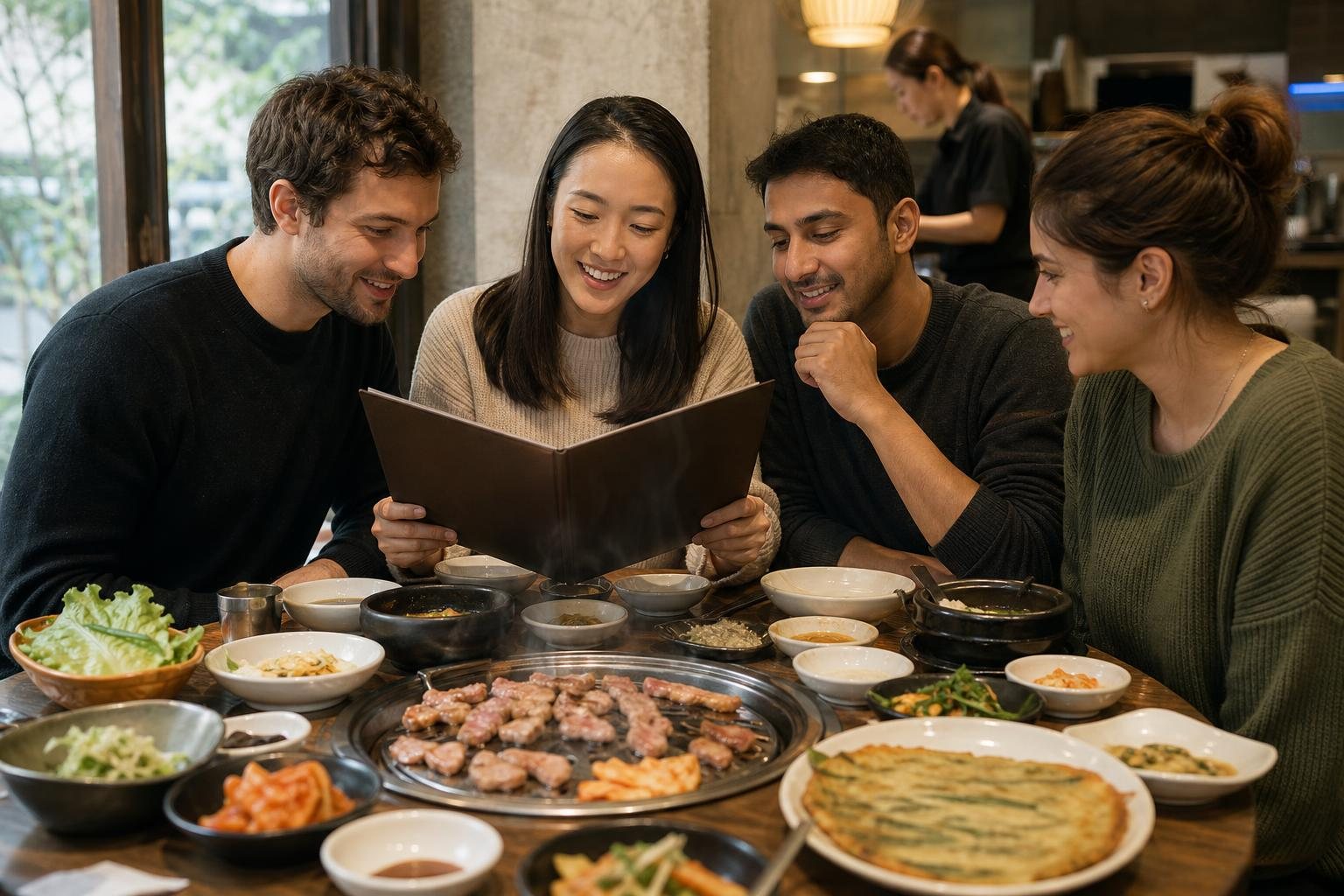
The key to ordering food in a Korean restaurant is to check whether a dish is for one person or for the table. Rice bowls, soups, stews, and noodle dishes are often individual meals. Barbecue, fried chicken, pancakes, hot pots, and large braised dishes are often shared.
Payment methods vary by restaurant, so follow signs or ask staff where to pay. Tipping is generally not expected; normally, you pay the displayed total without adding a separate tip.
Choose between an individual meal and shared food
Often suitable for one person
- Bibimbap and other rice bowls
- Gukbap, soups, and many jjigae stews
- Naengmyeon and other noodle dishes
- Baekban or set meals
A set meal can look substantial because it may include rice, soup, a main item, and several small side dishes. This rice-and-soup meal format with multiple side dishes is a familiar part of Korean dining. VisitKorea describes this style of set meal.
Often intended for sharing
- Korean barbecue
- Fried chicken
- Kimchi or seafood pancakes
- Hot pots and large stir-fried dishes
- Braised chicken, ribs, or seafood platters
- Multi-person set menus
Read the menu carefully for serving sizes, minimum orders, or a requirement to order two or more servings. Restaurant menu guidance published by the Korea Tourism Organization includes common notices about minimum servings and additional orders. See the Korean food translation guide.
How to read the menu
Do not rely on a photo alone to judge portion size. A picture may show a full table setting, optional additions, or food arranged for several diners.
- Look for notes such as “one serving,” “for two,” “set menu,” or “minimum order.”
- Check whether rice is included or must be ordered separately.
- Ask whether a dish is spicy if that matters to you.
- Wait for the main order before adding extra side dishes; small dishes may arrive with the meal.
Small side dishes are called banchan. They can include kimchi, vegetables, pickles, or seasoned items, and are commonly served alongside the main food.
A simple ordering process
- Decide whether your group wants individual meals, shared dishes, or both.
- Check serving notes before ordering barbecue, hot pot, fried chicken, or other large dishes.
- Order through the method used by that restaurant: staff, a table call button, a paper slip, QR ordering, a kiosk, or the counter.
- Start with the main food rather than ordering too many extras at once.
- Add more only after you see the portions and decide you need it.
Depending on the restaurant, you may find a call button, utensil drawer, self-service water station, side-dish station, or a grill built into the table. These are common features visitors may encounter. VisitKorea’s Korean food guide also notes that a spoon is normal for rice and soup.
Useful phrases to ask staff
- “Is this for one person or for sharing?”
- “How many people is this for?”
- “Can one person order this?”
- “Does this come with rice?”
- “Is it spicy?”
- “No pork, please.”
- “No seafood, please.”
- “Can we order one more?”
- “Where do we pay?”
If you have an allergy, dietary restriction, or ingredient you must avoid, ask about that specific ingredient. Broths, sauces, toppings, and side dishes can contain ingredients that are not obvious from a menu name.
Paying for your meal
There is no single payment routine for every Korean restaurant. You may pay at a counter after eating, use a kiosk before or while ordering, pay through a table-order system, or ask staff for the bill.
- Finish your meal and look near the entrance or counter for payment signs.
- If the process is not clear, ask, “Where do we pay?”
- Review the screen or receipt before confirming payment.
- Keep the receipt until you leave.
Confirm accepted payment methods with the restaurant if you have a preferred way to pay. The Korea Tourism Organization’s menu translation guidance includes examples of counter payment, kiosk payment, and payment before food is served.
If your group wants to split the cost, agree on the method before approaching the counter. Some restaurants can divide the total across several cards, while others prefer one payment for the table. Ask staff before presenting multiple cards, and use the amount shown on the receipt or payment screen as the final total.
Tipping in Korean restaurants
Tipping is generally not expected in Korean restaurants. The usual approach is to pay the amount shown by the restaurant. If a kiosk or card terminal shows an unfamiliar option, read the screen carefully and ask staff if needed.
Common mistakes to avoid
- Ordering too much immediately: Several shared dishes can quickly become more food than a group needs.
- Assuming barbecue is always a one-person order: Check serving units and minimum-order notes first.
- Mistaking banchan for extra orders: Wait until the main food arrives before deciding to add more.
- Waiting silently for help: Use the call button, raise your hand politely, or go to the counter.
- Assuming familiar-looking food is mild: Ask about spiciness before ordering.
FAQ
Can I eat alone at a Korean restaurant?
Yes. Rice bowls, soups, stews, noodle dishes, and many set meals are practical choices for one person. Check serving requirements before choosing barbecue or a large shared dish.
Is all Korean restaurant food shared?
No. Individual meals are common, especially rice bowls, soups, stews, and noodles. Sharing is more common with barbecue, pancakes, hot pots, fried chicken, and large braised dishes.
Do I need to order rice separately?
Sometimes. Rice may be included with a soup, stew, or set meal, but not with every dish. Check the menu or ask before ordering extra rice.
Can I eat the small dishes on the table?
They are usually side dishes served with the meal. Practices vary, so follow table signs and ask if you are unsure.
Should I leave a tip?
Generally, no. Tipping is not normally expected in Korean restaurants.
Where do I pay?
Look for signs near the entrance or counter, or ask staff. The payment point may be a counter, kiosk, or table-order system depending on the restaurant.
Related articles
- Eating Alone at a Korean Traditional Market: Ordering, Seating, and Portion Tips
- Incheon Airport to Seoul After Midnight: What to Check After a Delayed Flight
- Left a Bag in a Seoul Taxi? Find the Operator From Your Receipt or Booking
Information current as of: 2026-09-25