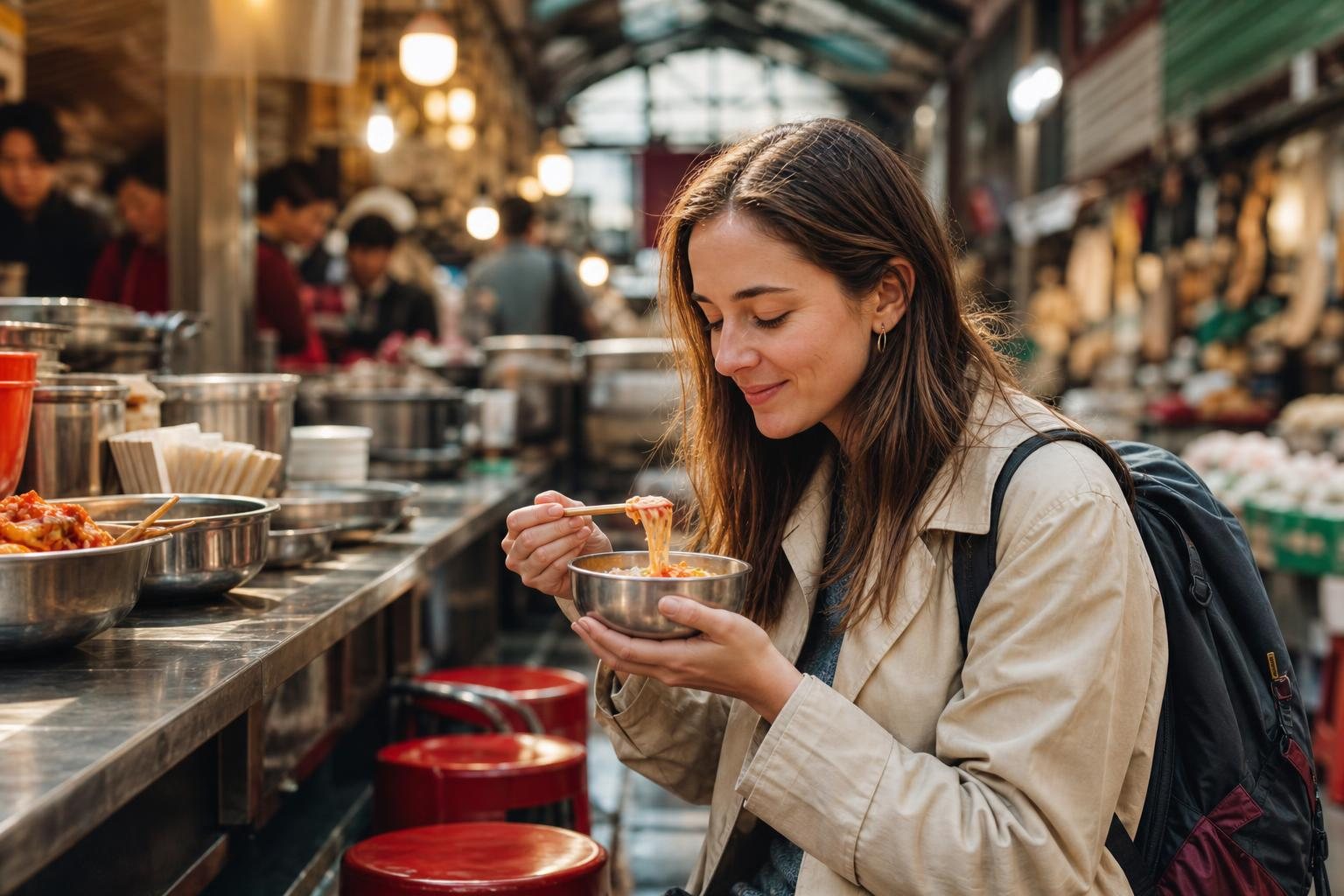
Eating alone at a Korean traditional market is easy once you choose the right stall. For a seated meal, look for a counter-style vendor with its own stools or tables; for casual browsing, choose a small snack that is easy to carry.
The most useful rule is to order first and ask before sitting down. Market layouts vary: some sellers have seating for their own customers, while other stalls are mainly for takeaway. Start with one item, then decide whether you want more.
The best solo-dining strategy
- Walk through the food area once before buying.
- Decide whether you want a proper seated meal or a few small snacks.
- Order one substantial item first.
- Add only one or two small items if you are still hungry.
- Ask whether you may eat at the stall before taking a seat.
Traditional markets can have noodle dishes, rice dishes, gimbap, pancakes, fried snacks, fish cakes, sweets, and skewers in the same area. Food stalls can be tempting when you are hungry, so a one-item-first approach helps avoid an overly large meal.
Choose the right type of stall
Counter or table-service stalls
If you want to sit down, look for a visible menu, an active cooking counter, and stools or tables immediately in front of the vendor. These stalls are often the simplest option for one person: order one menu item, confirm the seat, and eat there.
Solo-friendly choices may include noodles, a rice dish, gimbap, dumplings, or soup. A small plate of pancakes or fried food can also work when the vendor presents it as an individual order.
Do not assume that every table near a stall is shared public seating. At some market food alleys, tables are placed directly in front of individual shops for that shop’s customers. Seoul’s official travel guide notes the market-based food-stall setting at Seoul Central Market.
Snack stalls
Snack stalls are a good choice if you prefer to walk, browse, and try a little at a time. Common options include skewers, fish cakes, hotteok, croquettes, small breads, and fried snacks.
VISITKOREA’s guide to bunsik and street food introduces familiar items such as tteokbokki, fried foods, sundae, gimbap, fish cakes, and skewers. Pick a visibly individual item when you want a light stop rather than a full meal.
Prepared-food shops
If food is already packed in containers and there is no seating, treat it as takeaway unless the seller tells you otherwise. Some markets have both eat-in and takeout options, but the arrangement is different from shop to shop. VISITKOREA’s Mangwon-dong feature, for example, describes a mix of shops with seating and food that visitors eat standing nearby or take away.
How to order with limited Korean
You do not need a long conversation. Pointing to the menu or display, showing one finger, and asking one short question is usually enough.
- Look at the menu, photographs, or displayed food.
- Point to the item you want.
- Hold up one finger to show that you want one order.
- Ask whether it is one serving or whether a smaller amount is possible.
- Confirm whether you will eat there or take it away.
Useful phrases
- Igeo juseyo. — This one, please.
- Il-inbun juseyo. — One serving, please.
- Yeogi meogeodo dwaeyo? — May I eat here?
- Pojang haejuseyo. — Please pack it to go.
- Jogeumman juseyo. — Just a little, please.
If the menu has no English, use food photographs, watch what nearby customers receive, or use a translation app for a short question. Keep requests simple: “One serving?” and “Eat here?” are usually easier to communicate than a detailed customization request.
Where to sit
Ask before sitting at an empty table. A chair may belong to a particular vendor, be intended for waiting customers, or not be available for dining.
Order first, then ask: “Yeogi meogeodo dwaeyo?” — “May I eat here?”
When seating is crowded, choose food that is easy to carry, request takeaway packaging, continue browsing, or return later. Some markets include food courts or designated dining spaces, while others mainly consist of individual vendors. VISITKOREA’s traditional-market guide includes both food streets and food courts, illustrating how much layouts can differ.
How to avoid oversized portions
The most common solo-dining mistake is treating every market item as a small snack. Check what another customer receives before ordering, especially when the display shows large pancakes, mixed fried-food plates, chicken trays, shared platters, preset bundles, or food sold by weight.
Often easier for one person
- A bowl of noodles or soup
- One gimbap roll
- A skewer or fish cake on a stick
- One hotteok or filled bread
- A single croquette or similar fried snack
- A small serving of dumplings
A practical portion plan
- Option 1: One seated main dish.
- Option 2: One filling snack and one small extra.
- Option 3: Two light items, then pause before buying more.
When you see a large platter, ask for one serving rather than pointing to the entire display. Not every vendor can split or reduce a fixed portion, so accept the seller’s answer if a smaller order is not available.
A simple first-time example
- Walk through the food aisle without buying immediately.
- Choose a noodle or rice-based stall if you want to sit.
- Point to one item and say, “Il-inbun juseyo.”
- Ask, “Yeogi meogeodo dwaeyo?”
- Finish the main dish before deciding on another item.
- If you still want more, choose one small sweet or skewer.
This is usually easier than buying pancakes, fried snacks, gimbap, and dessert all at once.
Small etiquette habits that help
- Stay close to the stall where you bought food unless the seller directs you elsewhere.
- Do not assume another vendor’s chairs are shared seating.
- Step aside after ordering if the counter or aisle is narrow.
- Return trays, dishes, and utensils where the stall indicates.
- Carry tissues or napkins for convenience.
- Check payment arrangements at the stall before adding extra items, as methods can differ by shop.
Common mistakes to avoid
Ordering a full market feast immediately
Start with one item. You can always buy more after you eat, but carrying leftovers through a crowded market is inconvenient.
Using another stall’s table
Even when a table is empty, it may be intended for customers of the vendor who provides it. Asking first prevents confusion.
Expecting every stall to customize a portion
You can politely ask for a smaller amount, but some vendors sell only fixed portions. Choose an individual snack or a clear one-serving menu item if portion size matters.
FAQ
Is it okay to eat alone at a Korean traditional market?
Yes. A solo visitor can choose a counter-style stall, a snack stand, or a market dining area. Pick a vendor with visible seating when you want a relaxed sit-down meal.
Can I sit at any empty table?
No. Ask first because the table may belong to a specific vendor or be used by waiting customers.
What should I order if I do not want a large portion?
Start with a skewer, fish cake, hotteok, croquette, small gimbap option, or another visibly individual item. For a full meal, choose a dish clearly shown as one serving.
Can I ask for a smaller portion?
You can ask, but it may not be possible at every stall. Say “Jogeumman juseyo” or point to the food and ask for one serving.
Should I eat at the stall or take food away?
Follow the setup. If the stall has stools or tables directly in front, ask whether you may eat there. If food is packaged and there is no seating, takeaway is usually the simpler option.
What is the easiest phrase for solo ordering?
“Il-inbun juseyo” means “One serving, please.” Point to the food you want as you say it.
Traditional markets range from compact neighborhood markets to large food destinations. There is no single rule for every market, so observe the stall, order one item at a time, and ask before sitting. For broader market-travel information, see VISITKOREA’s traditional markets guide.
Related articles
- Incheon Airport to Seoul After Midnight: What to Check After a Delayed Flight
- Left a Bag in a Seoul Taxi? Find the Operator From Your Receipt or Booking
- How to Buy K-pop Concert Tickets in Korea: Official Sellers, Foreign Accounts, and Entry Checks
Information current as of: 2026-09-23